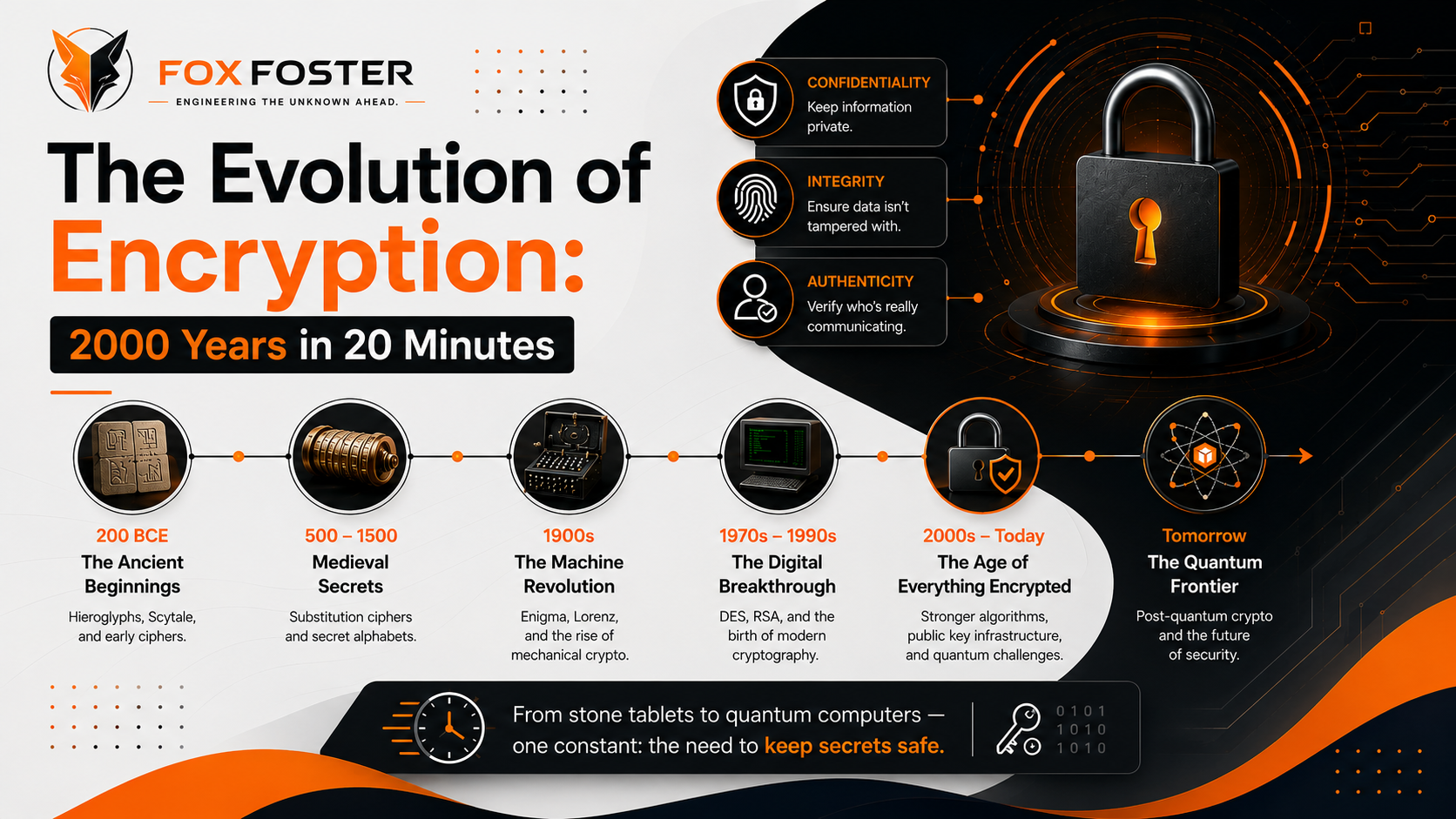
Why Secrets Have Always Needed Protecting
Before the invention of computers, there were times when people were faced with concealing messages. One of the problems they faced is how to send a message that can be read by only the person receiving it.
This is the tale of cryptography. It is a technique of transforming data into meaningless form against prying eyes, except the intended receiver. Through a span of two thousand years, cryptography has evolved from a mere technique of shifting letters in order to confuse the enemies to highly complex mathematics used for protecting your banking details online.
By the end of this blog, you will know the workings of the major forms of encryption, the reasons for their creation and their applications in the world today.
A Quick Trip Through Encryption History
Before diving into details, here is the big picture. Each breakthrough solved a weakness in the one before it.
| Year | Algorithm | Purpose |
|---|---|---|
| ~50 BC | Caesar Cipher | Hide military messages by shifting letters |
| 1553 | Vigenère Cipher | Use multiple shifting patterns to resist guessing |
| 1918 | Enigma Machine | Mechanically scramble messages for military use |
| 1977 | DES | First widely used digital encryption standard |
| 1977 | RSA | Allow secure communication without sharing a secret key first |
| 2001 | AES | Replace DES with a stronger, faster standard |
| 2000s | ECC | Provide strong security with smaller keys for mobile devices |
The Caesar Cipher
Short History
Named after Julius Caesar, this cipher was reportedly used to send secret orders to his army around 50 BC.
Why It Was Invented
Roman commanders needed a fast way to protect messages from being read if a messenger was captured.
How It Works
Every letter in the message is shifted a fixed number of places in the alphabet. Shift by 3, and A becomes D, B becomes E, and so on.
Advantages & Limitations
It was simple and quick, yet it only has 25 possible shifts making it easy to break it by hand in a matter of minutes. It is being utilized only for teaching the cryptography basics now.
Ancient CryptographyThe Vigenère Cipher
Short History
Published in 1553 by Giovan Battista Bellaso and later credited to Blaise de Vigenère, this cipher was considered unbreakable for nearly 300 years.
Why It Was Invented
The Caesar cipher was too easy to break. A stronger method was needed that did not rely on a single, predictable shift.
How It Works
Rather than using a single keyword cipher, this method applies a different keyword cipher to each letter in the message. Each letter is treated as though it possesses its own keyword, which varies according to the approach.
Advantages & Limitations
Much harder to crack than Caesar because the same letter can encrypt differently each time. Its weakness is that short or repeated keywords create patterns that skilled codebreakers can eventually find. It is now historical, used mainly in cryptography education.
Mechanical EraThe Enigma Machine
Short History
Invented in 1918 and used heavily by Germany during World War II, Enigma was a machine, not a hand cipher.
Why It Was Invented
Military communication needed encryption that changed constantly and could not be solved by hand, even with time and effort.
How It Works
Typing a letter sent an electrical signal through a set of rotating wheels called rotors. Each rotor scrambled the letter differently, and the rotors turned after every keystroke, so the same letter rarely encrypted the same way twice.
Advantages & Limitations
Enigma produced billions of possible settings, making it extremely tough to crack. Allied codebreakers, including Alan Turing's team, eventually broke it using early computing machines and operator mistakes. It is no longer used but is remembered as a turning point in cryptography and computing history.
Digital EraDES (Data Encryption Standard)
Short History
Developed by IBM and adopted by the US government in 1977, DES was the first major standard for encrypting digital data.
Why It Was Invented
Computers were becoming common, and businesses and governments needed a shared, standardized way to encrypt digital information.
How It Works
DES breaks data into 64-bit blocks and scrambles each block through 16 rounds of substitution and rearrangement, using a 56-bit secret key shared by both sender and receiver.
Advantages & Limitations
In this time, DES was a fast and dependable encryption method but it now is outdated. The increase in computing speeds rendered DES's 56-bit keys inefficient because the encrypted data could be cracked in just a couple of hours.
Digital EraAES (Advanced Encryption Standard)
Short History
Selected by the US government in 2001 after a public competition, AES replaced DES as the global encryption standard.
Why It Was Invented
DES was no longer safe enough, and the world needed a faster, stronger algorithm suited for modern computers.
How It Works
If you shuffle a deck of cards several times, you will have a shuffled deck each time. It becomes hard to guess the exact order of cards after each shuffle. In a similar way, AES performs repeated substitutions and rearrangements of data in different rounds with the use of a key of 128, 192, or 256 bits.
Advantages & Limitations
AES is fast, strong, and has withstood over two decades of attempts to break it. Its main limitation is that both parties must safely share the same secret key beforehand. AES protects Wi-Fi, disk encryption, messaging apps, and much of the internet's stored data today.
Public Key EraRSA Encryption
Short History
Created in 1977 by Rivest, Shamir, and Adleman, RSA introduced the idea of "public key" encryption to the world.
Why It Was Invented
Sharing a secret key safely over long distances was risky. RSA solved this by removing the need to share a secret key at all.
How It Works
There are two types of keys: a public key which can be publicly seen and which is accessible to everyone; and second is private key which only belongs to the owner and which can be accessed by only him/her. Once data is locked with the help of public key, it can be unlocked with the help of private key only, just like a box wherein anyone can deposit letters but only the owner of the box has the access to it.
Advantages & Limitations
In the process of using RSA, the step of transfer of shared keys has been removed, which is a good thing but RSA is usually much slower than AES, leaving RSA to be used only for the transmission of a small key, like for AES computation.
Public Key EraDiffie-Hellman Key Exchange
Short History
Published in 1976 by Whitfield Diffie and Martin Hellman, this was the breakthrough that made public key cryptography possible.
Why It Was Invented
Two people who had never met needed a way to agree on a shared secret key over a public, watched channel.
How It Works
Picture mixing paint. Both people start with a shared public color, add their own secret color, and swap results. Each then mixes in their own secret again, arriving at the same final color, which an eavesdropper cannot easily reverse-engineer.
Advantages & Limitations
Diffie-Hellman lets two strangers agree on a secret without ever sending the secret itself. On its own it does not verify identity, so it is often combined with digital signatures. It remains the foundation of secure connections like HTTPS and VPNs.
Modern Public KeyElliptic Curve Cryptography (ECC)
Short History
Introduced in the mid-1980s and widely adopted from the 2000s onward, ECC offers RSA-level security using far smaller keys.
Why It Was Invented
Mobile phones and small devices needed strong encryption without the heavy processing power RSA demands.
How It Works
ECC uses the mathematics of points on a curved line rather than large prime numbers. Bouncing between points on this curve creates a problem that is extremely hard to reverse, even with a much shorter key.
Advantages & Limitations
Smaller keys mean faster performance and less battery drain, ideal for phones, smart cards, and IoT devices. It is mathematically more complex to implement correctly. ECC now secures modern browsers, cryptocurrencies, and messaging apps like Signal.
Trust & VerificationDigital Signatures
Short History
Built on public key ideas from the late 1970s, digital signatures became practical once RSA and similar systems matured.
Why It Was Invented
Encryption hides messages, but it does not prove who sent them. Digital signatures solve the problem of trust and authenticity.
How It Works
The person sending the message will employ their private key for the purpose of affixing their "signature" to their message so as to generate a unique mark. The message recipient or anyone else may authenticate the signature, effectively verifying that the message actually came from the sender.
Advantages & Limitations
While digital signatures provide evidence of who generated the document and indicate that it has not been altered, these signatures only work when the private key has not been compromised. Once a private key is stolen, digital signatures using this key are not worth anything anymore. This technology is being used in different types of software updates, electronic contracts, and secure communications.
Where All This Encryption Lives Today
These algorithms rarely work alone. Most modern systems combine several of them, using each for what it does best — RSA or ECC to exchange a key safely, and AES to encrypt the actual data quickly.
| Application | Encryption Used |
|---|---|
| HTTPS Websites | RSA / ECC + AES |
| Wi-Fi Networks | AES |
| Messaging Apps | ECC + AES |
| Online Banking | RSA / ECC + AES |
| Cryptocurrency | ECC + Digital Signatures |
| Software Updates | Digital Signatures |
The Future of Encryption
Quantum computers- the newest problem to deal with. Quantum computers are capable of being able to solve the problems on which RSA and ECC depends at a much quicker rate than the computers we have today and, thereby, be able to break the protection that these systems provide.
This caused the researchers to come up with "post-quantum cryptography". Post-quantum cryptography consists of various algorithms that are capable of withstanding quantum attacks. Many countries as well as companies from the high-tech sector are already starting using these standards.
Two Thousand Years, One Simple Goal
The goal of encryption has never changed, from Caesar shifting letters in battle to AES protecting online shopping and ECC making your phone safe from prying eyes and unauthorized access.
At every stage, each solution from this list was developed to solve a particular problem related to encryption. As technology continues to improve, new solutions will emerge based on lessons learned from their predecessors.
Algorithms at a Glance
| Algorithm | Type | Security | Used Today |
|---|---|---|---|
| Caesar Cipher | Substitution | Very Weak | No |
| Vigenère Cipher | Polyalphabetic | Weak | No |
| Enigma | Mechanical Rotor | Weak (by today's standards) | No |
| DES | Symmetric | Weak | No |
| AES | Symmetric | Very Strong | Yes |
| RSA | Asymmetric | Strong | Yes |
| Diffie-Hellman | Key Exchange | Strong | Yes |
| ECC | Asymmetric | Very Strong | Yes |
Further Reading
- National Institute of Standards and Technology (NIST) — Cryptographic Standards and Guidelines
- NIST — Advanced Encryption Standard (FIPS 197)
- NIST — Post-Quantum Cryptography Project
- Original research papers: Diffie & Hellman (1976), Rivest, Shamir & Adleman (1977)