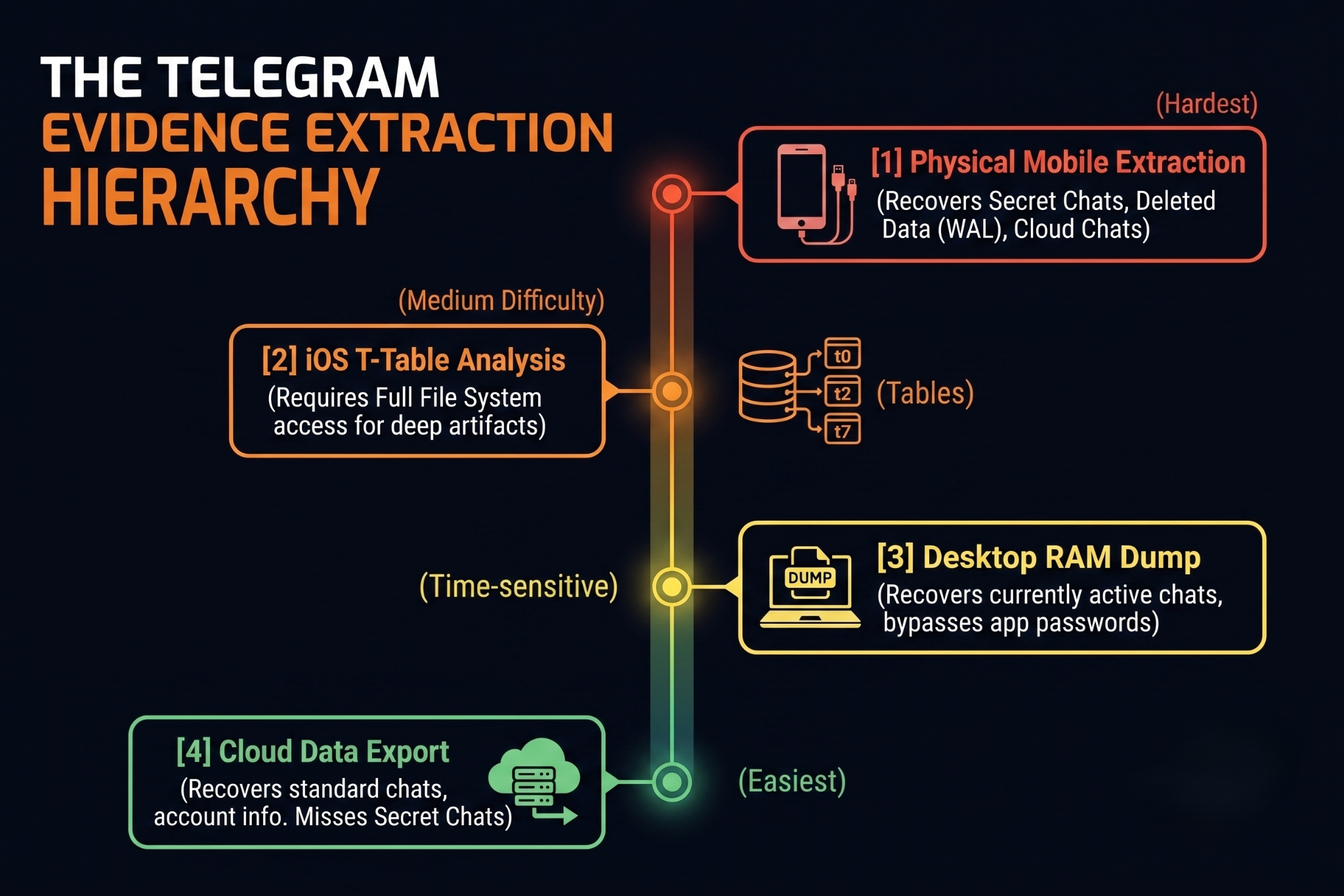
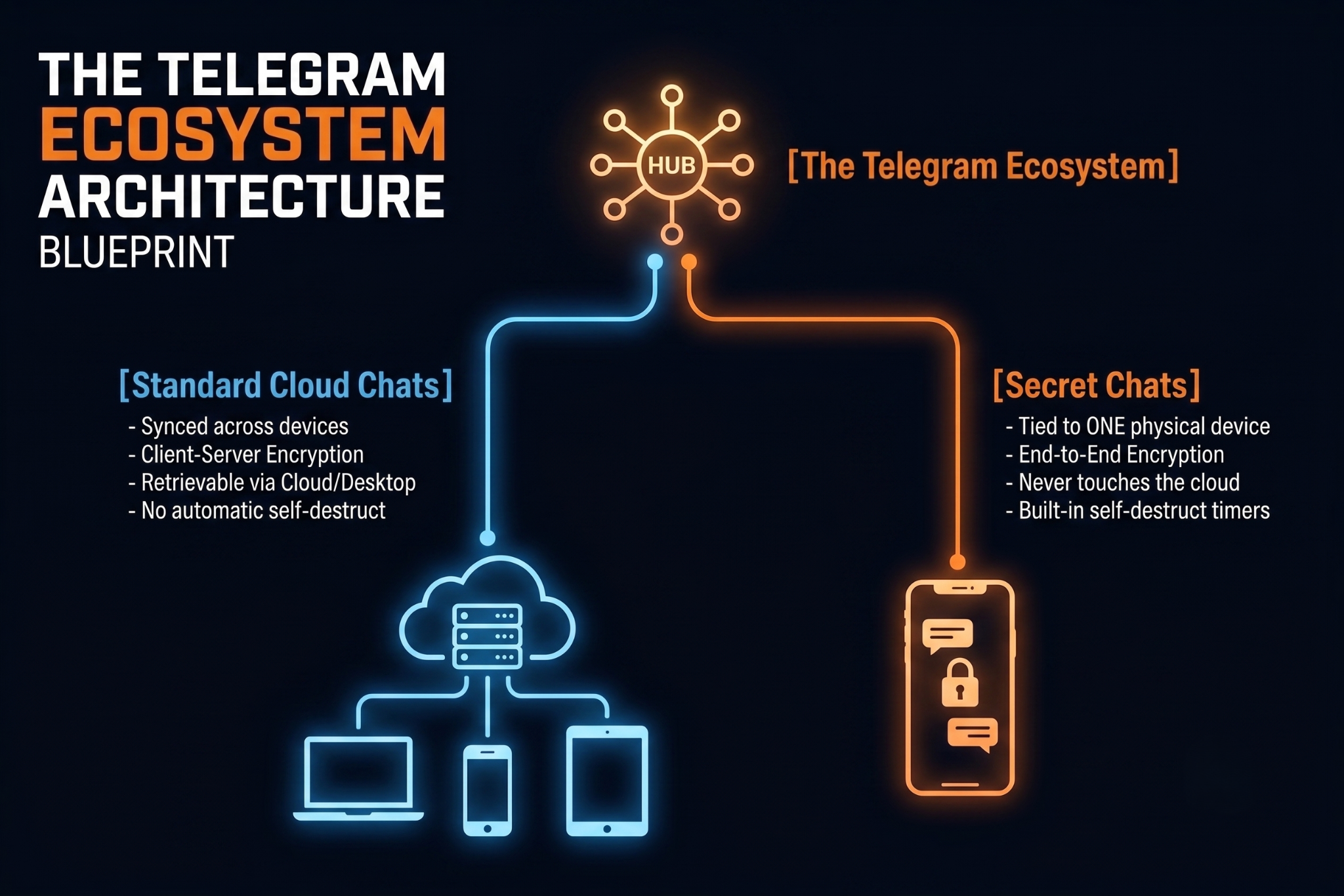
Telegram forensics revolves around understanding its dual-layered architecture: standard "Cloud Chats" can be extracted from any synced device, while end-to-end encrypted "Secret Chats" demand physical access to the specific mobile device used. Investigators analyze hidden SQLite databases, custom binary tables, and volatile memory to recover deleted messages, self-destructing media, and hidden user networks.
The Memory Anchor
Think of Telegram as a two-tier intelligence agency. Standard chats are the Central Archives—secured in a massive, locked vault (Telegram's servers), but accessible by the agent from any computer or phone using their credentials. "Secret Chats," however, are Burn-Bag Operations—agents passing handwritten notes directly to each other on the street. These notes never touch the central vault and are designed to burst into flames (self-destruct) after reading. If you want the central archive, you can extract it from the cloud. If you want the burn-bag notes, you must physically seize the exact pockets (the mobile device) they were placed in.
The Fundamental Divide: Cloud vs. Secret Chats
Telegram is fundamentally different from WhatsApp. WhatsApp stores all your data on your phone. Telegram, by default, is a cloud-based messenger.
- Cloud Chats: Messages, media, and groups are synced with Telegram's servers using client-server encryption. If a suspect loses their phone, they can log in on a laptop and see everything.
- Secret Chats: These use true end-to-end encryption. They are device-specific, never backed up to the cloud, cannot be forwarded, block screenshots (on Android), and feature self-destruct timers.
Practical Approach 1: Android Artifact Analysis (The cache4.db Target)
On Android, Telegram hides its data inside a protected application sandbox. You generally need a rooted device or advanced extraction tools to reach it.
- The Path: Data is stored at
/data/data/org.telegram.messenger/files/. - The Main Database (cache4.db): This is the master SQLite database (a lightweight database software used in mobile devices). It holds contacts, chat logs, and metadata.
- The BLOB Hurdle: Unlike WhatsApp, which stores text in plain, readable columns, Telegram stores messages as a BLOB (Binary Large Object, a complex data block). You cannot just open the database and read it. Investigators must use a deserializer tool (like teleparser) to translate Telegram's custom internal language (MTProto) back into human-readable text, photos, and GPS coordinates.
- Write-Ahead Logs (WAL): The
cache4.db-walfile temporarily holds recent activity. If a suspect deletes a message quickly, it might still live in this temporary log for days before the system permanently erases it.
Practical Approach 2: iOS Artifact Analysis (The T-Tables)
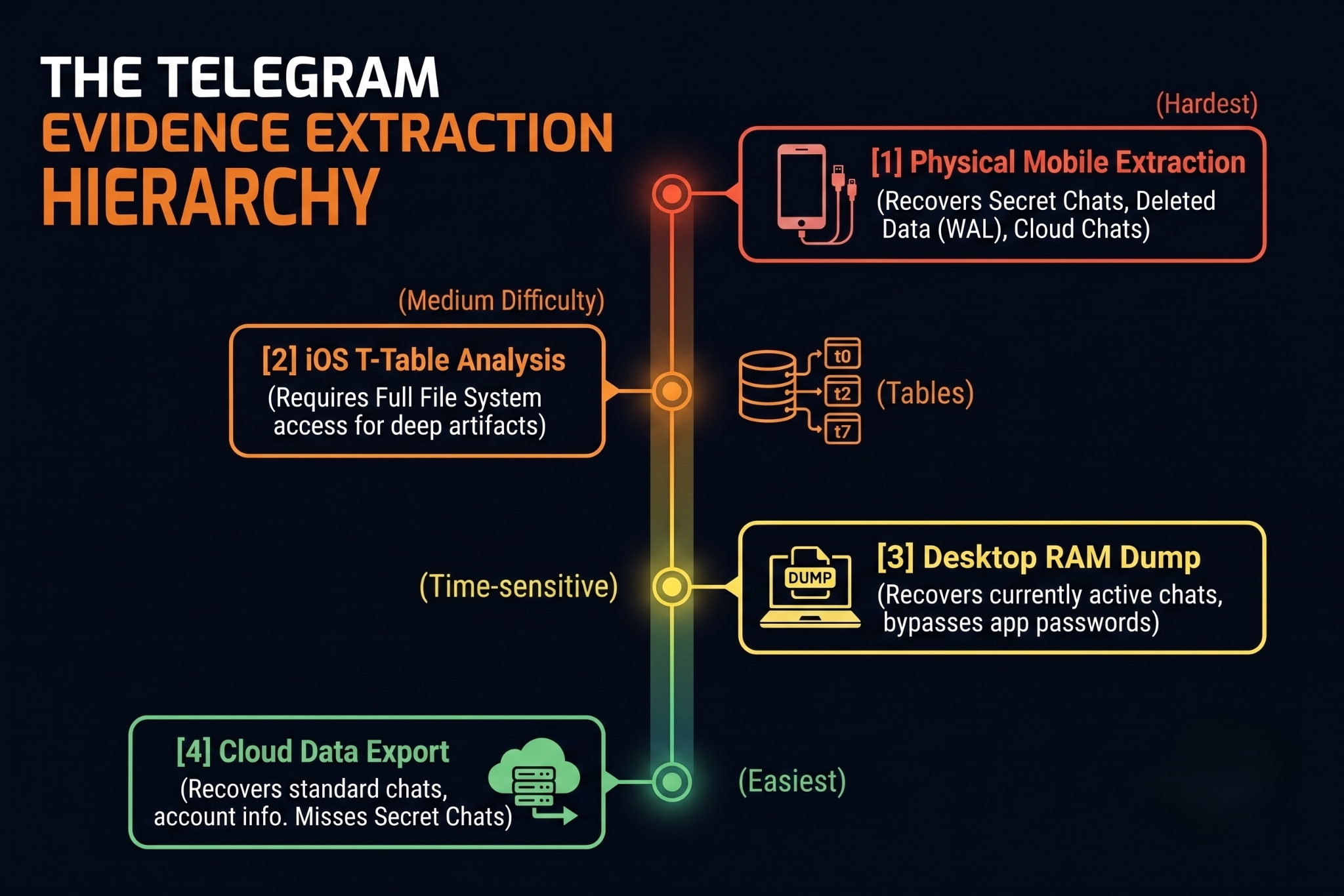
Apple devices handle Telegram entirely differently. Telegram purposely blocks its data from being included in iTunes or iCloud backups. To get it, investigators must perform a Full File System (FFS) extraction using hardware bypasses (like checkm8).
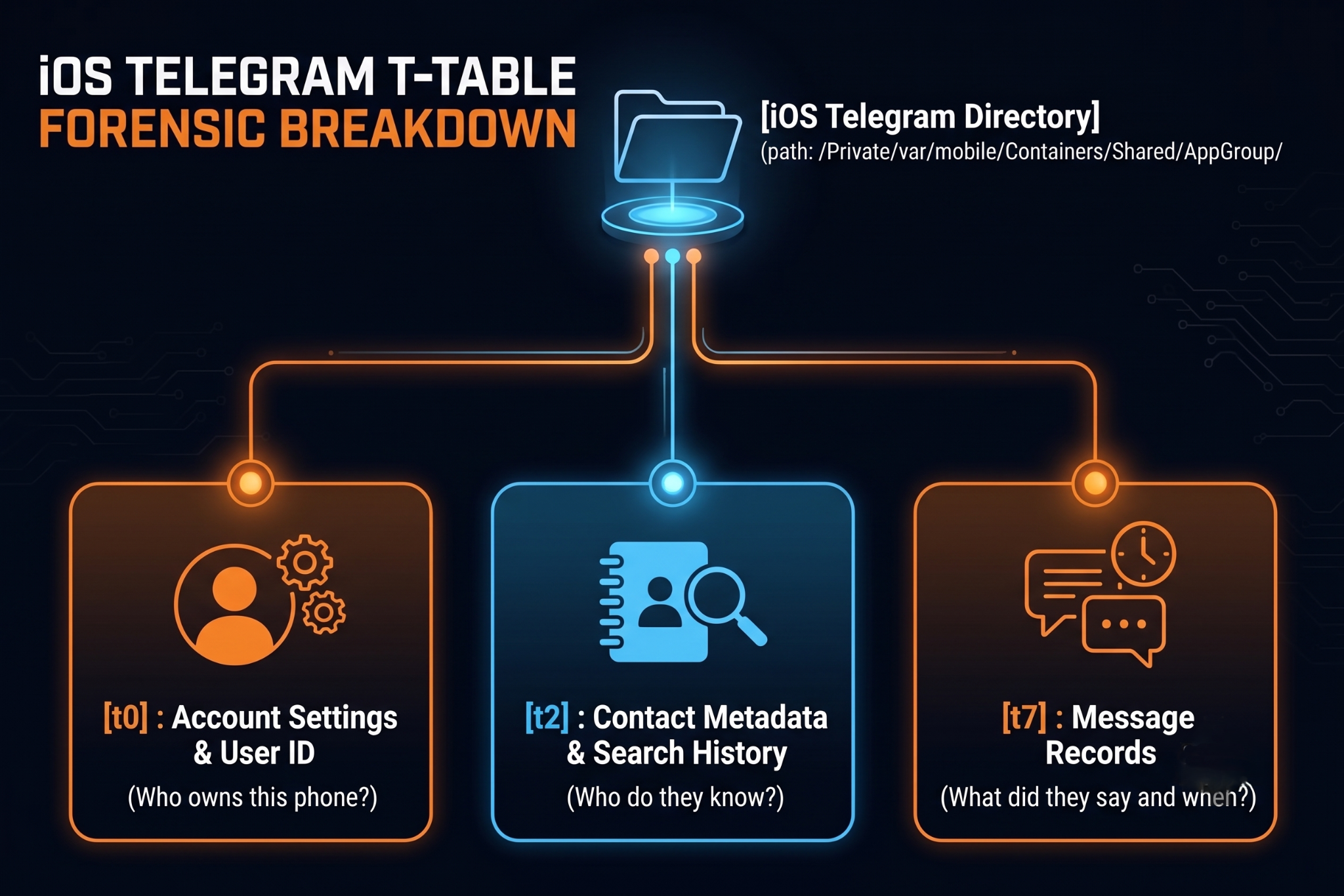
- The Path: Stored deep in the iOS file system under
/Private/var/mobile/Containers/Shared/AppGroup/. - The Custom Format: iOS Telegram does not use a standard SQLite database. It uses a custom binary format split across specific "T-Tables."
- Table t0: Holds the account owner's settings and numeric Telegram ID.
- Table t2: Holds contact metadata (names, profile pictures).
- Table t7: The holy grail. This holds the actual message records, organized by the chat and the timestamp.
The "False Evidence" Trap: Beware the Search Cache
Here is a unique learning insight that catches amateur forensic analysts off guard: Just because a contact is in the database doesn't mean the suspect talked to them.
- The Cache Problem: On iOS, the t2 table caches (temporarily saves) the results of any global search the user performs.
- The Scenario: If a user searches for a dark-web drug channel but never joins it or messages it, Telegram still saves that channel's name and image to the t2 database so it loads faster next time.
- The Rule: You must cross-reference the t2 contact list with the t7 message list. If a contact has zero associated messages, it is likely a search cache artifact, not proof of a relationship or conspiracy.
Practical Approach 3: Desktop and Volatile Memory (RAM)
Criminals often operate complex schemes from laptops using Telegram Desktop. Because Telegram Desktop can be locked with a local passcode, extracting data from the hard drive can hit a dead end.
- The RAM Strategy: If the computer is powered on and Telegram is running in the background, investigators use tools to dump the RAM (Random Access Memory, the temporary workspace a computer uses while turned on).
- Memory Artifacts: By scanning the raw memory dump, investigators can locate the
HistoryMessageobject. Even if the hard drive is encrypted and the app is locked, the decrypted messages are sitting in plain text in the computer's volatile memory. Once the laptop is turned off, this evidence vanishes forever.
Practical Approach 4: Exporting Data (The Non-Forensic Alternative)
Sometimes, physical extraction fails, or the device is destroyed. If investigators can legally seize the suspect's SIM card, they can log into Telegram Desktop or Web and generate a JSON (a standard text-based data format) export.
- What you get: Complete account details, active sessions, group chat histories, and all sent/received media.
- What you lose: Secret chats (because they aren't in the cloud) and deleted messages (which might have been recoverable from the phone's physical WAL files but are scrubbed from the cloud export).
The Golden Rules of Telegram Forensics
- Target the Device First: Because of Secret Chats, the cloud is only a backup plan. The physical phone is always the primary target.
- Isolate Immediately: Put the device in a Faraday bag (a shield that blocks all cellular and Wi-Fi signals) instantly. If the device connects to the internet, a co-conspirator can use Telegram's "Remote Wipe" feature to instantly destroy the cloud data and the local database.
- Check the Hidden Forwarders: When extracting messages, pay attention to forwarded text. Even if the sender tries to hide their identity, the Telegram database often retains the hidden user's internal ID in the metadata, proving the original source of the forwarded contraband or intelligence.