Abstract
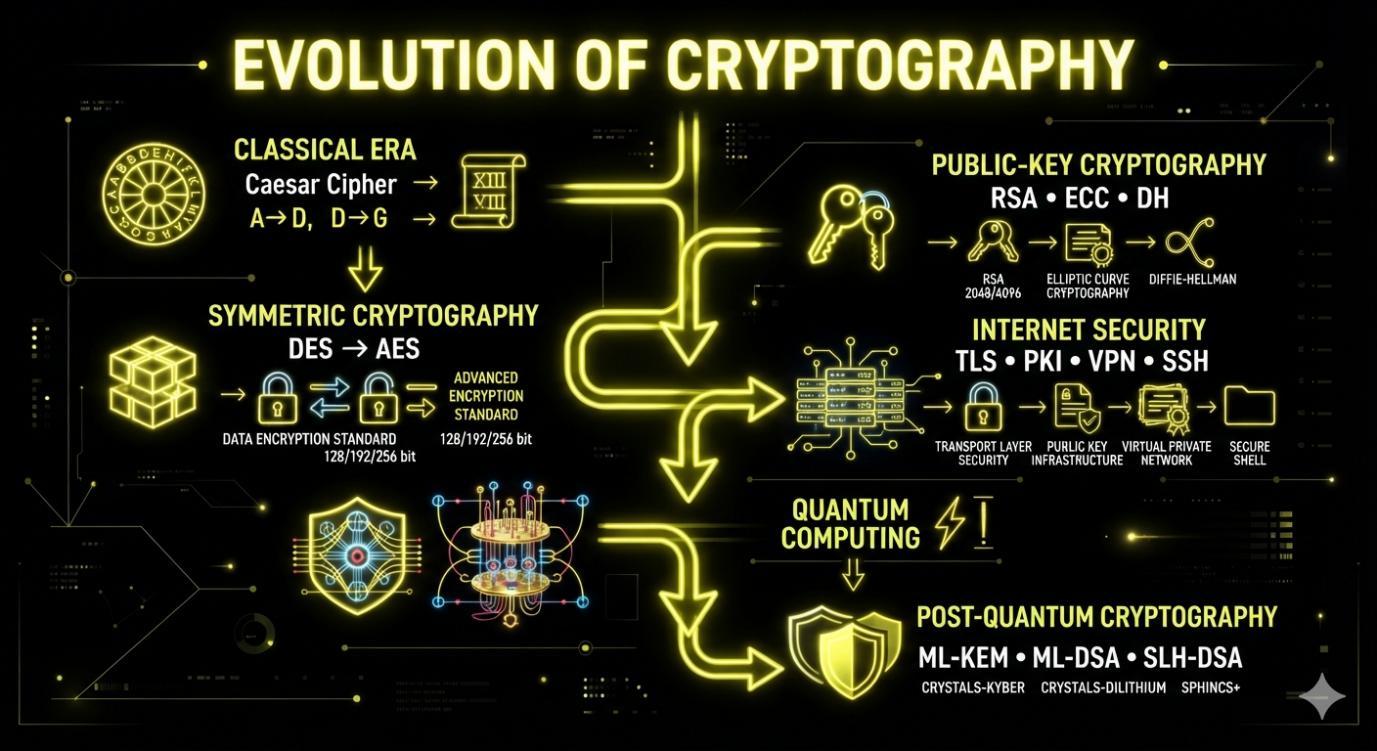
For decades, modern cybersecurity has relied on a fundamental assumption: certain mathematical problems require an impractical amount of time to solve using classical computers. Public-key cryptography—including RSA, Elliptic Curve Cryptography (ECC), and Diffie–Hellman—derives its security from this assumption.
Quantum computing challenges that assumption:
Unlike traditional computers that process information as binary digits, quantum computers manipulate quantum states that obey the principles of quantum mechanics. This shift is not merely about faster computation; it introduces an entirely different computational model capable of solving specific classes of problems far more efficiently than classical systems.
This article explores the relationship between quantum computing and cybersecurity from a technical perspective. Rather than focusing on speculation, it examines the scientific principles behind quantum computation, explains why current cryptographic systems are affected, and introduces the security challenges organizations will face during the transition to the post-quantum era.
Part 1 — Foundations of Quantum Computing and the Evolution of Cybersecurity
1. Introduction
Cybersecurity has continuously evolved alongside computing technology. When personal computers became common, antivirus software emerged. When organizations adopted the Internet, firewalls became essential. Cloud computing introduced identity-based security and Zero Trust architectures. Artificial Intelligence transformed malware detection, threat hunting, and behavioral analytics. Quantum computing represents the next major technological shift.
Unlike previous advances, quantum computing has the potential to change the mathematical assumptions on which much of modern cryptography is built.
This does not mean that all encryption will suddenly become insecure. Rather, it means security professionals must begin preparing for cryptographic systems that remain trustworthy even in the presence of large-scale quantum computers. Understanding this transition requires understanding quantum computing itself.
2. Why Classical Computers Have Limits
Every digital device today—from smartphones to enterprise servers—uses classical computation. Classical processors operate using bits. A bit can exist in only one of two possible states: "0 or 1". Even the world's fastest supercomputers ultimately perform enormous numbers of binary operations every second.
Increasing performance traditionally involves: higher clock frequencies, more processor cores, better cache architectures, parallel execution, and specialized accelerators such as GPUs. These improvements increase computational capacity but do not change the underlying computational model.
Certain mathematical problems remain computationally difficult regardless of hardware improvements. Examples include: Integer Factorization, Discrete Logarithm Problems, and Elliptic Curve Discrete Logarithm Problems. These hard problems form the security foundation of much of today's public-key cryptography.
3. Enter Quantum Computing
Quantum computers do not replace classical computers. Instead, they introduce a fundamentally different method of processing information. Rather than storing information as bits, quantum computers use quantum bits, commonly called qubits. A qubit behaves according to the laws of quantum mechanics rather than classical electronics.
This allows quantum algorithms to explore computational pathways that classical systems cannot efficiently represent. Quantum computers therefore excel only at particular categories of problems: optimization, quantum chemistry simulation, certain search problems, and specific cryptographic mathematics.
Tasks such as browsing the web, watching videos, or editing documents are not expected to become inherently faster simply because a quantum processor is used.
4. Understanding Qubits
A classical bit is deterministic — "0 or 1". A qubit is represented mathematically as a quantum state. Without diving into advanced linear algebra, it is useful to think of a qubit as a system capable of representing probabilities until it is measured. Once measurement occurs, the qubit collapses into one classical outcome. This property enables quantum algorithms to manipulate information differently from traditional algorithms.
However, qubits are extremely fragile. Small environmental disturbances—including heat, electromagnetic interference, and vibration—can alter their quantum state. Because of this sensitivity, practical quantum computers require sophisticated engineering, cryogenic cooling, and extensive error correction.
5. Superposition
Superposition is often described inaccurately as "a qubit being both 0 and 1 simultaneously." While this simplification is useful for beginners, it does not capture the underlying physics. A better way to understand superposition is that a qubit exists in a quantum state capable of producing different outcomes when measured.
Before measurement, quantum algorithms manipulate probability amplitudes rather than fixed binary values. This allows quantum algorithms to evaluate solution spaces in fundamentally different ways compared with classical algorithms. Importantly, superposition alone does not make quantum computers exponentially faster. Performance improvements arise only when algorithms successfully exploit quantum phenomena.
6. Entanglement
Entanglement is one of the defining characteristics of quantum computation. When two qubits become entangled, their quantum states become correlated. Operations performed during computation take advantage of these correlations to build algorithms that cannot be efficiently reproduced on classical hardware.
Entanglement enables complex computational relationships between qubits, making it an essential resource for scalable quantum algorithms. Without entanglement, many of the most powerful quantum algorithms would not be possible.
7. Quantum Interference
Quantum algorithms rely on interference to guide computation toward correct answers. Constructive interference increases the probability of correct solutions. Destructive interference suppresses incorrect solutions. Rather than blindly searching every possibility, quantum algorithms manipulate probability amplitudes so that useful outcomes become increasingly likely after measurement. This concept differentiates genuine quantum algorithms from simple parallel processing.
8. Quantum Gates
Classical processors execute logic gates such as AND, OR, XOR, and NOT. Quantum computers instead use quantum gates. Examples include: Hadamard Gate, Pauli-X, Pauli-Y, Pauli-Z, Phase Gate, CNOT Gate, SWAP Gate, and Toffoli Gate.
Quantum gates manipulate probability amplitudes rather than binary values. A sequence of these operations forms a Quantum Circuit, analogous to a classical program.
9. Quantum Circuits
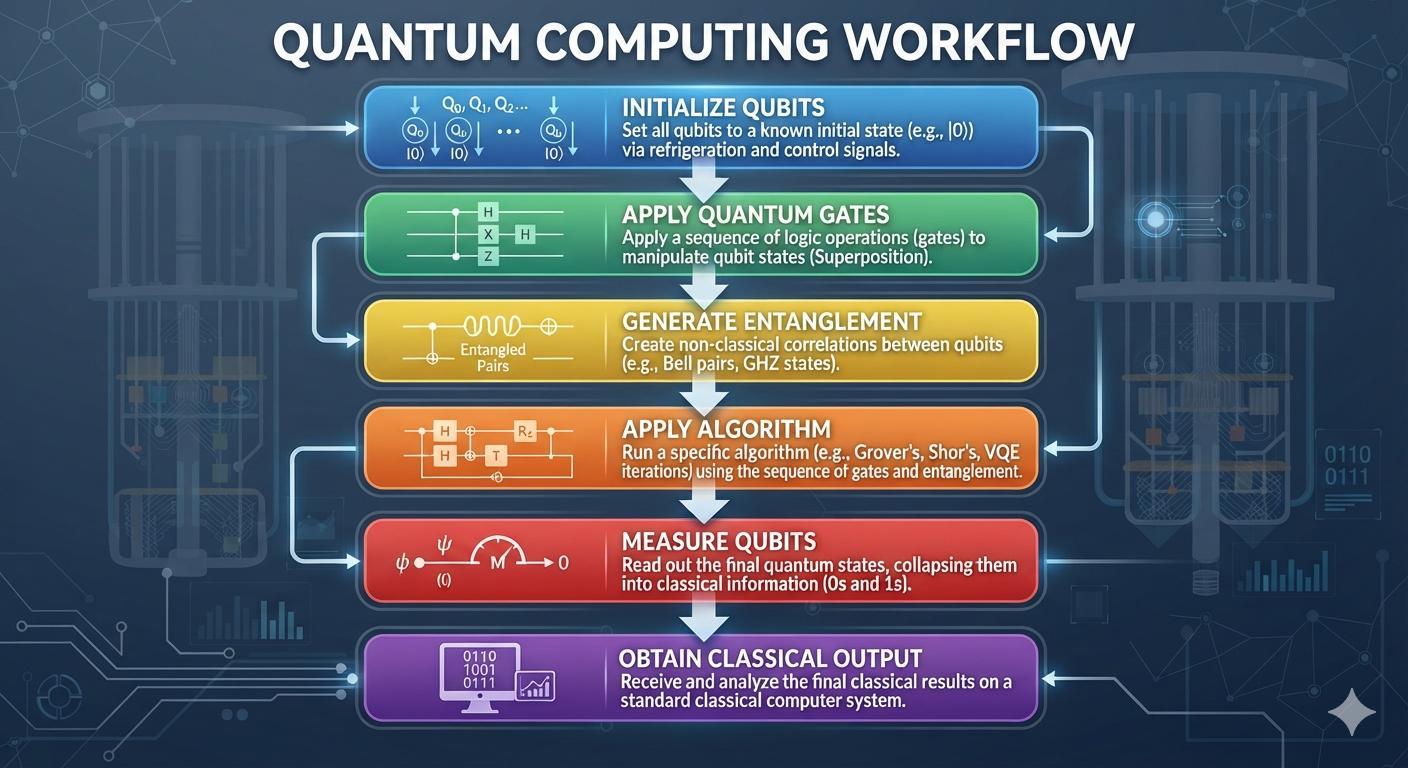
Quantum software is constructed as circuits rather than conventional instruction streams. A typical quantum workflow consists of: initial state preparation, application of quantum gates, and final measurement. Measurement converts quantum information back into classical bits that conventional computers can interpret. Most practical quantum systems therefore operate alongside classical processors rather than replacing them entirely.
10. Why Cybersecurity Professionals Should Care
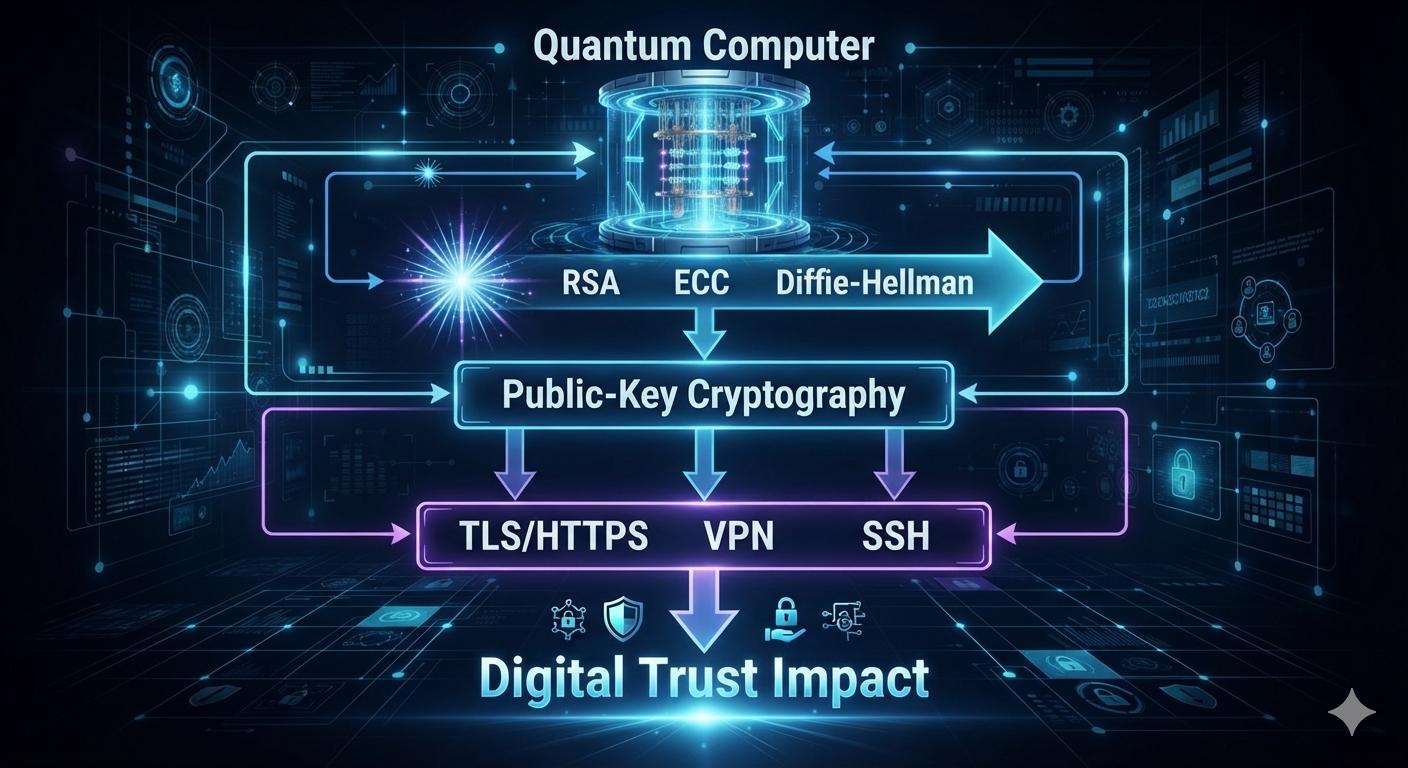
At first glance, quantum computing appears to be a topic for physicists rather than security professionals. However, modern cybersecurity depends heavily on cryptography. Examples include: HTTPS, VPNs, SSH, Digital Certificates, Secure Email, Blockchain, Software Signing, Authentication Protocols, and Cloud Identity Systems.
Many of these technologies rely on mathematical assumptions that quantum algorithms may solve more efficiently than classical algorithms. As a result, cybersecurity professionals are increasingly preparing for a gradual migration toward Post-Quantum Cryptography (PQC)—cryptographic algorithms designed to remain secure even against future quantum-capable adversaries.
Preparing early is important because cryptographic transitions across global infrastructure often take many years. Systems deployed today may still be in service when quantum-capable attacks become practical, making long-term planning a key component of modern cyber resilience.
- Quantum computing introduces a new computational model rather than simply faster hardware.
- Qubits, superposition, entanglement, and interference form the foundation of quantum computation.
- Quantum algorithms target specific classes of mathematical problems rather than every computing task.
- Much of today's public-key cryptography relies on assumptions that are believed to be difficult for classical computers.
- The emergence of quantum computing is driving the global transition toward post-quantum cryptography and crypto-agility.
Part 2 — Modern Cryptography and the Quantum Threat Landscape
11. Cryptography: The Foundation of Digital Trust
Before understanding how quantum computing affects cybersecurity, it is essential to understand why modern cryptography exists. Every secure digital interaction—whether accessing an online banking portal, sending an encrypted email, updating cloud infrastructure, signing software, or authenticating to an enterprise VPN—depends on cryptographic mechanisms.
Contrary to a common misconception, cryptography is not designed solely to encrypt information. Modern cryptographic systems provide multiple security guarantees:
- Confidentiality – Ensures that only authorized parties can read protected information.
- Integrity – Detects unauthorized modifications to data during storage or transmission.
- Authentication – Verifies the identity of users, devices, or services.
- Non-Repudiation – Prevents a sender from denying that they originated a digitally signed message.
Together, these properties form the foundation of digital trust across the Internet.
12. Classification of Modern Cryptography
Modern cryptographic systems are broadly categorized into three families:
12.1 Symmetric Cryptography
Symmetric cryptography uses one shared secret key for both encryption and decryption. Characteristics: extremely fast, efficient for large datasets, commonly hardware accelerated, suitable for disks, databases, VPN tunnels, and network traffic. Examples include AES and ChaCha20. One major limitation is secure key distribution: both communicating parties must already possess the same secret key before encrypted communication can begin.
12.2 Asymmetric Cryptography
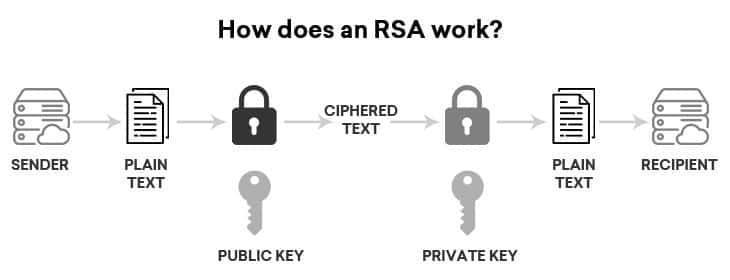
Asymmetric cryptography addresses the key distribution problem by introducing two mathematically related keys: a Public Key and a Private Key. The public key may be distributed openly, while the private key remains confidential. This innovation made secure Internet communication practical because strangers could exchange encrypted information without first sharing a secret. Common algorithms include RSA and Elliptic Curve Cryptography (ECC).

12.3 Hash Functions
Unlike encryption, hash functions are one-way mathematical transformations. Important properties include: deterministic output, fixed-length digest, avalanche effect, collision resistance, and pre-image resistance. Hash functions are widely used in password storage, digital signatures, file integrity verification, blockchain, and certificate validation. Modern examples include SHA-256 and SHA-3.
13. Public Key Infrastructure (PKI)
The Internet functions securely because organizations trust digital certificates issued by Certificate Authorities (CAs). This ecosystem is known as the Public Key Infrastructure (PKI). Without PKI, users would have no reliable way to verify that they are communicating with the intended service rather than an impersonator.

14. RSA: Why It Became the Internet Standard
RSA is one of the earliest and most influential public-key cryptographic systems. Its security is based on a mathematical observation: multiplying two very large prime numbers is computationally straightforward, while recovering those original primes from their product is believed to be computationally infeasible for classical computers at practical key sizes. This asymmetry makes RSA suitable for key exchange, digital signatures, and certificate authentication.
The practical security of RSA depends primarily on key length and proper implementation rather than secrecy of the algorithm itself.
Simplified RSA Lifecycle: Generate Large Prime Numbers → Compute Public Parameters → Create Public & Private Keys → Publish Public Key → Protect Private Key → Encrypt / Verify → Decrypt / Sign
15. Elliptic Curve Cryptography (ECC)
ECC achieves comparable security using significantly smaller key sizes than RSA. Rather than relying on integer factorization, ECC is based on the computational difficulty of the Elliptic Curve Discrete Logarithm Problem (ECDLP).
Advantages include: smaller keys, reduced bandwidth, faster computations, lower storage requirements, and better suitability for mobile and embedded devices. ECC is therefore widely deployed in TLS, SSH, VPN technologies, mobile devices, IoT platforms, and secure messaging applications.
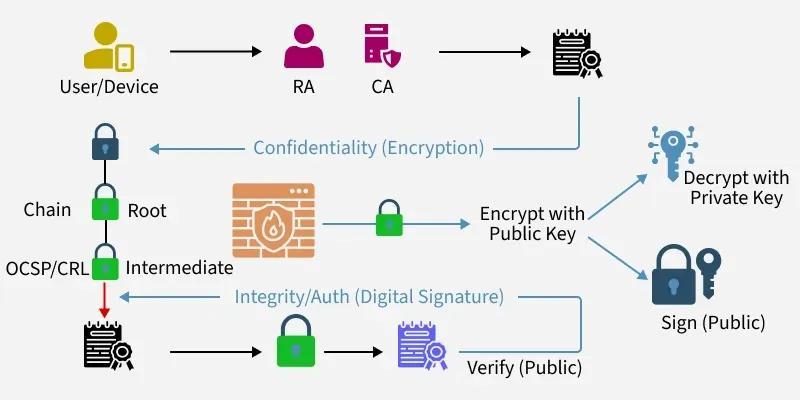
16. Diffie–Hellman Key Exchange
One of cryptography's most important achievements is enabling two parties to establish a shared secret over an untrusted communication channel. Diffie–Hellman solves exactly this problem: instead of transmitting the secret directly, each participant performs independent mathematical operations that ultimately produce the same shared secret. The shared secret can then be used with a symmetric algorithm such as AES for efficient encrypted communication.
17. TLS: Securing the Modern Internet
Transport Layer Security (TLS) protects data exchanged between clients and servers. Every time a user visits a secure website, a TLS handshake establishes: server authentication, session key agreement, confidential communication, and integrity protection. Modern TLS implementations often combine asymmetric cryptography for authentication with symmetric cryptography for bulk data encryption.
18. Where Quantum Computing Changes the Equation
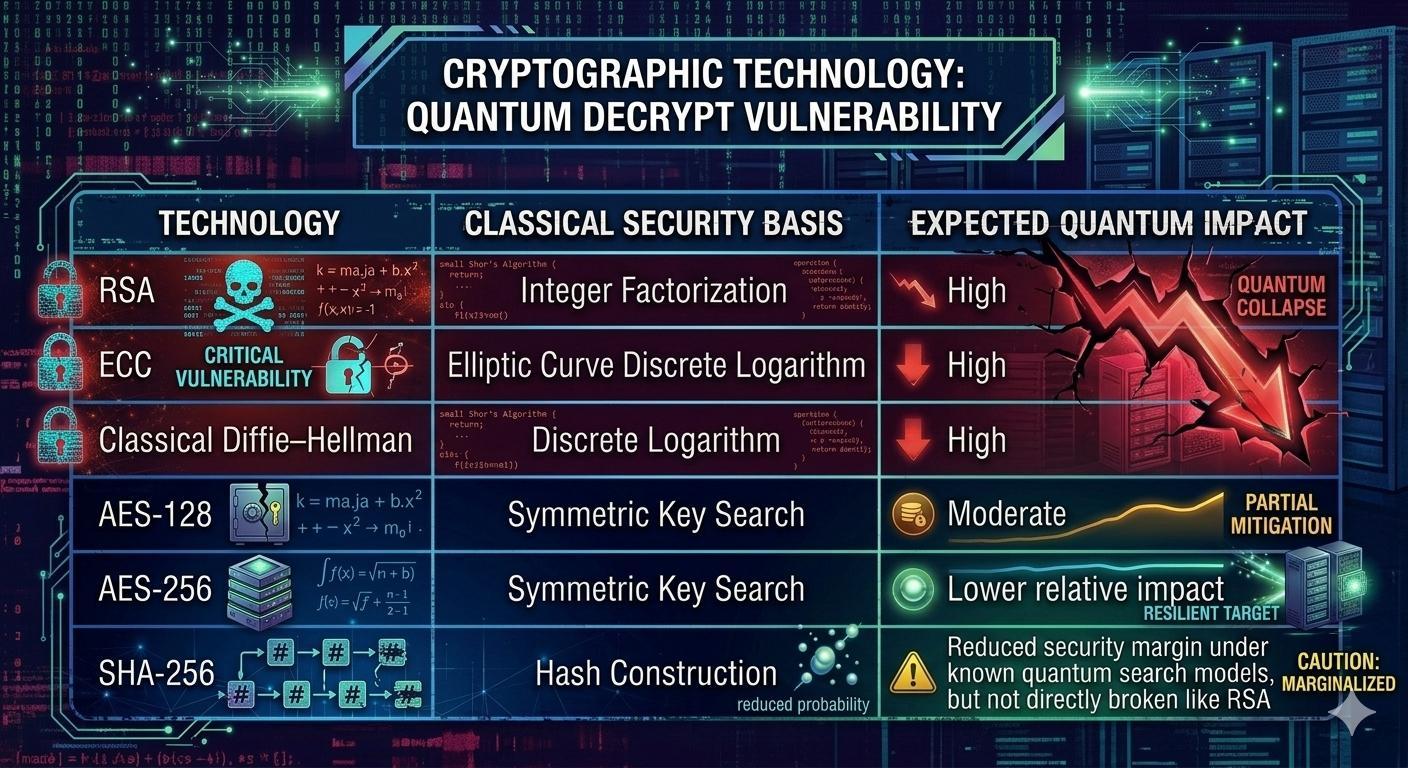
The security of RSA, ECC, and classical Diffie–Hellman depends on mathematical problems that are considered difficult for classical computers. Quantum computing introduces algorithms that can solve certain classes of these problems much more efficiently than the best-known classical algorithms.
It is important to distinguish between breaking encryption instantly and changing long-term security assumptions. Quantum computing does not make every cryptographic algorithm obsolete. Instead, it affects specific mathematical foundations while leaving others comparatively resilient. This distinction is critical for planning future cryptographic migrations.
19. Cryptographic Impact Assessment
The following summarizes the expected impact of large-scale quantum computers on major cryptographic categories:
- Symmetric Cryptography (AES, ChaCha20): Impact — Minor. Requires increased key sizes (e.g., AES-256).
- Hash Functions (SHA-2, SHA-3): Impact — Minor. Requires increased output lengths.
- Public-Key Cryptography (RSA, ECC, DH): Impact — Significant. Requires complete replacement with PQC.
- Digital Signatures: Impact — Significant. Requires migration to quantum-resistant schemes.
This comparison highlights an important takeaway: the primary quantum challenge is public-key cryptography, while symmetric cryptography and hash functions generally require parameter adjustments rather than complete replacement.
20. Crypto Agility: Preparing for Change
Historically, cryptographic algorithms remained in production for decades. The quantum era introduces a different requirement: crypto agility. Crypto agility is the ability of an organization to replace or upgrade cryptographic algorithms without redesigning its entire infrastructure.
Organizations with strong crypto agility can: inventory cryptographic assets, replace vulnerable algorithms efficiently, support hybrid deployments during migration, respond to future cryptographic advances, and reduce long-term operational risk. For many enterprises, crypto agility is expected to become just as important as vulnerability management or patch management.
- Cryptography provides confidentiality, integrity, authentication, and non-repudiation.
- Modern Internet security combines symmetric encryption, asymmetric cryptography, hash functions, and PKI.
- RSA, ECC, and Diffie–Hellman derive security from mathematical problems that are believed to be difficult for classical computers.
- Large-scale quantum computers primarily threaten these public-key systems rather than all cryptographic techniques.
- Organizations should focus on crypto agility and long-term migration planning.
Part 3 — Offensive Analysis: Quantum Threats Against Modern Cryptography
21. Introduction
The discussion around quantum computing often leads to the statement: "Quantum computers will break encryption." While this statement attracts attention, it oversimplifies a much more nuanced reality.
Quantum computers do not threaten every cryptographic primitive equally. Some algorithms are expected to become significantly weaker under large-scale quantum computation, while others require only parameter adjustments to maintain security. Furthermore, the practical risk depends not only on algorithm design but also on the maturity, scale, and error-correction capabilities of future quantum hardware.
For defenders, the real challenge is not reacting after practical quantum attacks become available. The challenge is preparing years in advance because cryptographic migrations across global infrastructure are slow, complex, and operationally expensive.
22. Understanding the Quantum Threat Model
A threat model identifies what an adversary wants to achieve, which assets are targeted, and what capabilities are required. In the context of quantum computing, a future adversary with access to a sufficiently capable fault-tolerant quantum computer could theoretically target cryptographic systems that rely on mathematical problems vulnerable to known quantum algorithms.
The primary objectives may include: recovering private keys, forging digital signatures, impersonating trusted services, decrypting previously captured encrypted communications, undermining certificate-based trust, and weakening long-term confidentiality.

Unlike conventional cyberattacks, the focus is not exploiting software vulnerabilities but reducing the computational difficulty of certain mathematical problems.
23. Quantum Algorithms Relevant to Cybersecurity
Quantum computing derives much of its security relevance from a small number of algorithms specifically designed to outperform classical approaches for particular problem classes. The two most significant are:
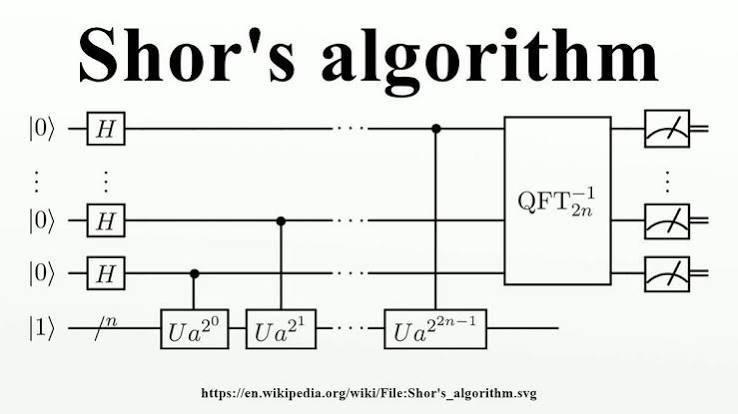
Shor's Algorithm
Designed for problems involving: Integer Factorization, Discrete Logarithms, and Elliptic Curve Discrete Logarithms. These problems underpin much of today's public-key cryptography.
Grover's Algorithm
Designed for unstructured search problems. Instead of directly breaking symmetric encryption, Grover's Algorithm reduces the effective complexity of exhaustive key search, meaning larger symmetric keys are generally sufficient to maintain strong security margins.

These algorithms affect different cryptographic systems in different ways, making accurate risk assessment essential.
24. Why RSA Becomes Vulnerable
RSA security relies on the computational difficulty of factoring very large composite integers. For classical computers, no efficient algorithm is known that makes large-scale factorization practical at modern key sizes.
Quantum computing changes this assumption: a sufficiently capable implementation of Shor's Algorithm could solve the underlying factorization problem dramatically more efficiently than the best-known classical techniques. This does not mean existing RSA deployments fail today. It means that organizations relying on RSA for long-term confidentiality should begin migration planning well before practical quantum computers become available.
Potential consequences include: certificate compromise, digital signature forgery, secure session establishment risks, and PKI trust degradation.
25. Impact on Elliptic Curve Cryptography (ECC)
ECC was introduced to provide comparable security with significantly smaller keys than RSA. Its efficiency made it the preferred choice for mobile devices, IoT systems, HTTPS, VPN technologies, secure messaging, and SSH.
However, ECC relies on the Elliptic Curve Discrete Logarithm Problem. Large-scale quantum computers executing Shor's Algorithm are expected to affect this mathematical foundation similarly to RSA. Because ECC is widely deployed across modern infrastructure, migration planning is particularly important.
26. Diffie–Hellman Key Exchange
Diffie–Hellman enables two parties to establish a shared secret across an untrusted communication channel. The protocol itself is elegant and remains foundational to secure communications. However, its classical security depends upon the computational hardness of discrete logarithm problems. Consequently, sufficiently capable quantum computers may significantly reduce the security assumptions underlying classical Diffie–Hellman implementations. Organizations therefore evaluate alternative key-establishment mechanisms designed for post-quantum environments.
27. Digital Certificates and PKI
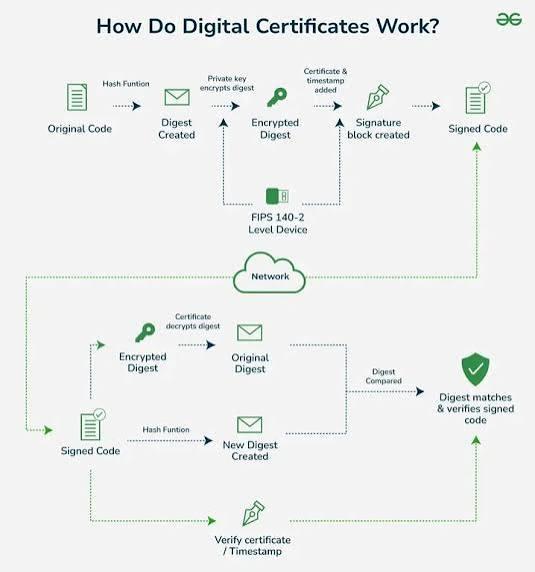
Public Key Infrastructure depends upon asymmetric cryptography. Certificate Authorities issue digitally signed certificates that allow clients to authenticate servers. If the underlying signature algorithms become vulnerable, trust relationships throughout the Internet could eventually require replacement.
Potentially affected areas include: HTTPS, Secure Email, Enterprise VPNs, Software Signing, Firmware Verification, Code Signing, Cloud Identity, and Device Authentication. The challenge extends beyond replacing algorithms. Entire certificate lifecycles, trust stores, hardware security modules, and enterprise PKI deployments must also evolve.

28. Harvest Now, Decrypt Later (HNDL)
One of the most widely discussed strategic concerns in quantum security is commonly referred to as: Harvest Now, Decrypt Later (HNDL).
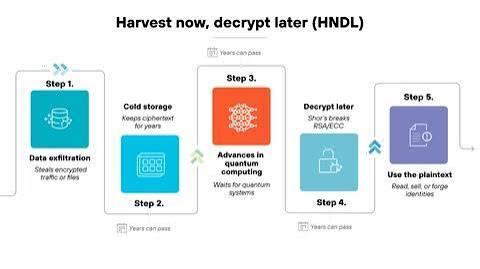
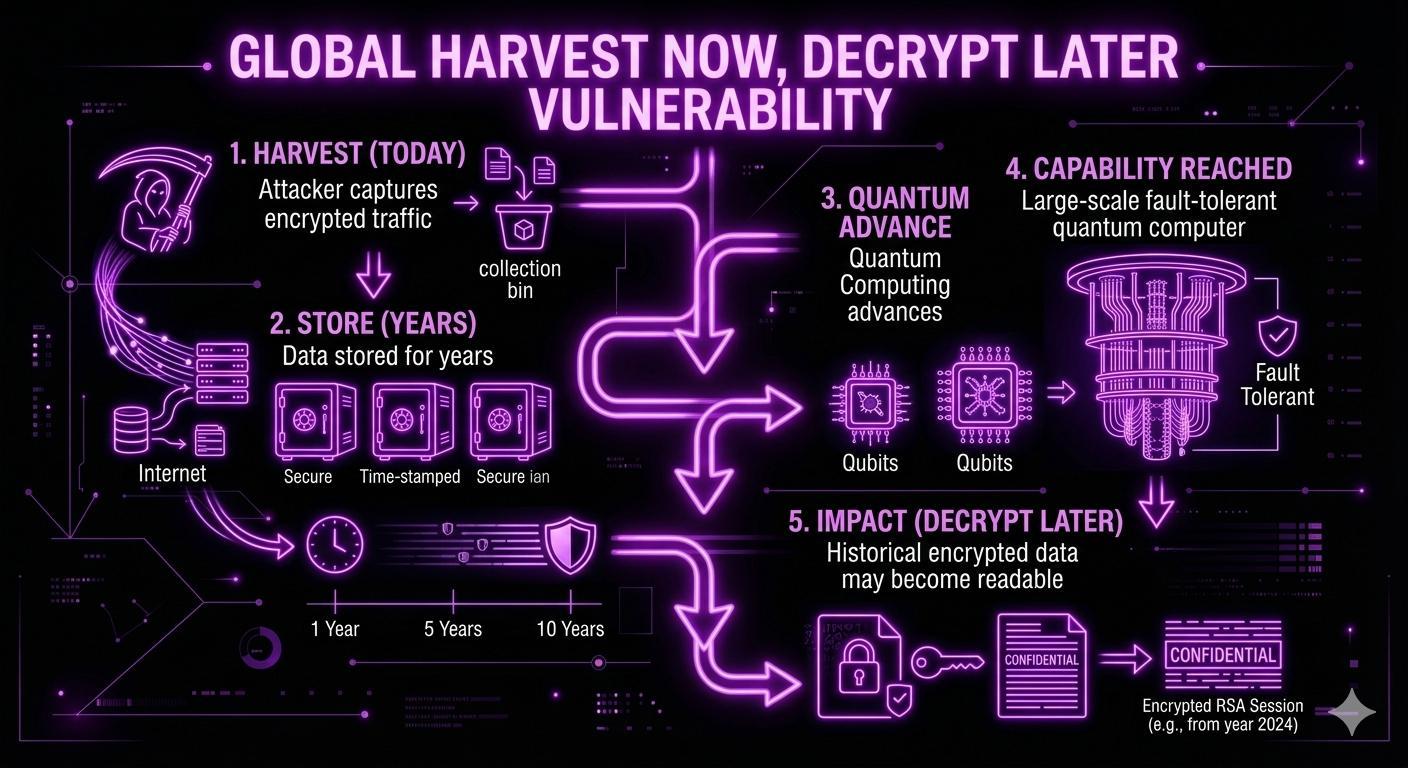
The concept is straightforward. An adversary may capture encrypted communications today—even if they cannot currently decrypt them—and retain those encrypted datasets for future analysis. If practical quantum capabilities become available years later, historical communications protected by vulnerable public-key systems could potentially be exposed.
This risk is especially relevant where information retains value over long periods, such as: government communications, diplomatic records, healthcare data, intellectual property, research archives, financial records, and defense documentation. The concern is therefore about long-term confidentiality, not immediate compromise.
29. Enterprise Risk Assessment
Organizations should evaluate quantum risk based on the lifespan of their sensitive information. Not all data requires protection for decades.
A practical assessment may consider:
- Banking Transactions — Medium confidentiality requirement
- Software Updates — High confidentiality requirement
- Government Records — Very High confidentiality requirement
- Medical Records — Very High confidentiality requirement
- Military Communications — Critical confidentiality requirement
- Trade Secrets — High confidentiality requirement
- Research Data — High confidentiality requirement
- Identity Documents — Very High confidentiality requirement
Data expected to remain sensitive for many years should receive priority during post-quantum migration planning.
30. Industries Most Likely to Be Affected
Quantum-related cryptographic transition is expected to influence multiple sectors.
Financial Services — Digital banking, payment systems, interbank communication, transaction authentication.
Government — National identity systems, classified communication, public infrastructure.
Healthcare — Electronic health records, medical research, patient confidentiality.
Cloud Providers — Identity management, certificate infrastructure, API authentication, customer encryption services.
Telecommunications — Core network security, subscriber authentication, infrastructure management.
Software Vendors — Code signing, package repositories, update mechanisms, supply chain security.
31. Blockchain Considerations
Blockchain systems rely extensively on public-key cryptography. Different blockchain platforms use different signature schemes, so the impact varies depending on implementation. The discussion is therefore less about "breaking blockchain" and more about understanding which cryptographic components may eventually require migration to quantum-resistant alternatives.
Areas of interest include: wallet authentication, transaction signatures, long-term key management, and smart contract ecosystems. Research into quantum-resistant blockchain designs is already underway across academia and industry.
32. Offensive Perspective vs Defensive Reality
It is important to distinguish theoretical offensive capability from practical cybersecurity reality. A future quantum-capable adversary would still require: large-scale fault-tolerant quantum hardware, stable logical qubits, effective quantum error correction, and significant computational resources.
These engineering challenges remain substantial. Therefore, the cybersecurity community is focused on preparedness rather than panic. Migration planning today is intended to prevent emergency transitions tomorrow.
- Quantum computing primarily affects certain public-key cryptographic assumptions rather than all encryption.
- RSA, ECC, and classical Diffie–Hellman are expected to require migration toward quantum-resistant alternatives.
- The "Harvest Now, Decrypt Later" strategy highlights the importance of protecting information with long-term confidentiality requirements.
- Public Key Infrastructure, digital certificates, software signing, and secure communications all depend on cryptographic trust that must evolve over time.
- The greatest current cybersecurity priority is proactive planning, crypto agility, and adoption of standardized post-quantum cryptography rather than assuming immediate widespread quantum attacks.
Part 4 — Preparing for the Post-Quantum Era: Defensive Strategies, Enterprise Readiness, and the Future of Cybersecurity
The previous sections explained how quantum computing introduces new risks for modern cryptography. However, the cybersecurity community is not waiting for these threats to become practical. Governments, standards organizations, cloud providers, and enterprises are already preparing for a transition toward Post-Quantum Cryptography (PQC).
Rather than replacing every existing cryptographic algorithm overnight, the transition focuses on building crypto-agile systems that can gradually adopt quantum-resistant technologies while maintaining compatibility with existing infrastructure.
34. Post-Quantum Cryptography (PQC)
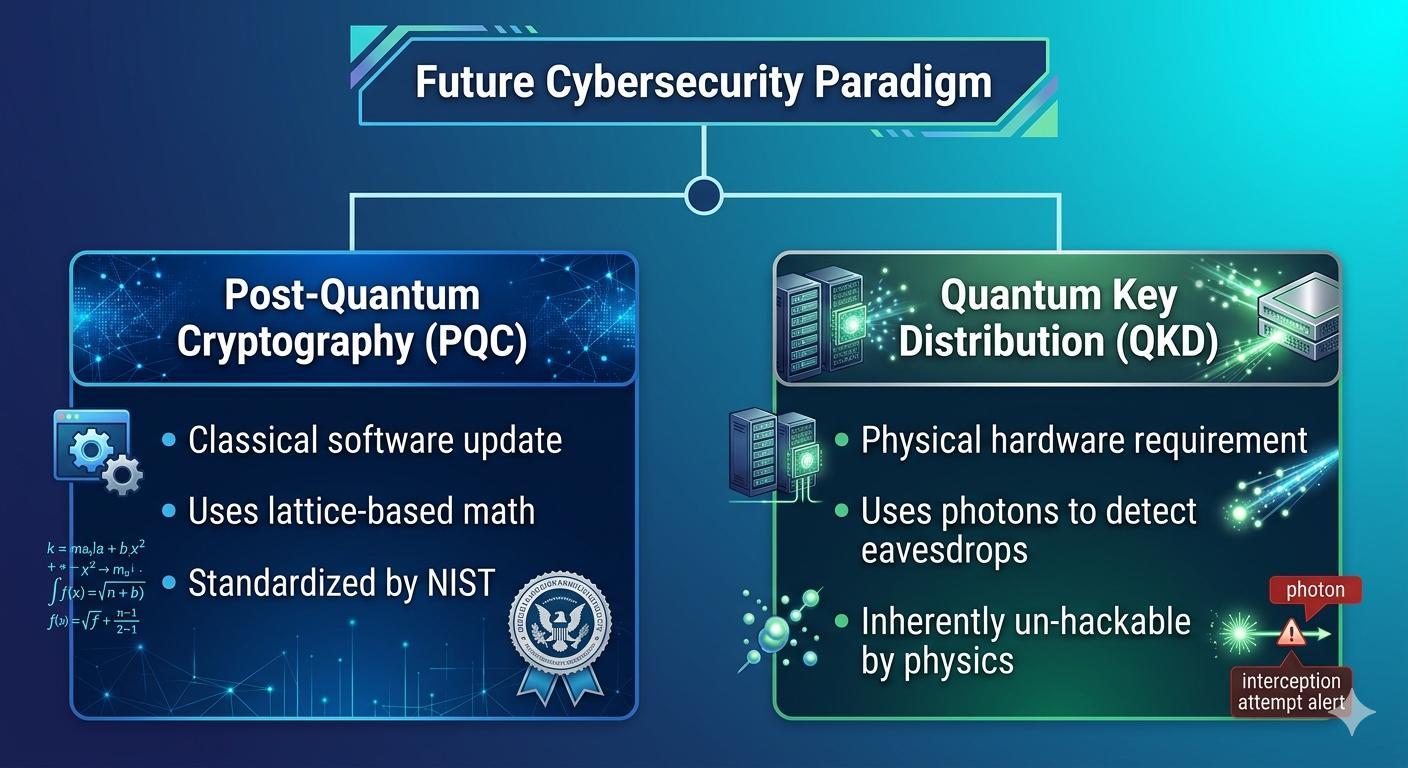
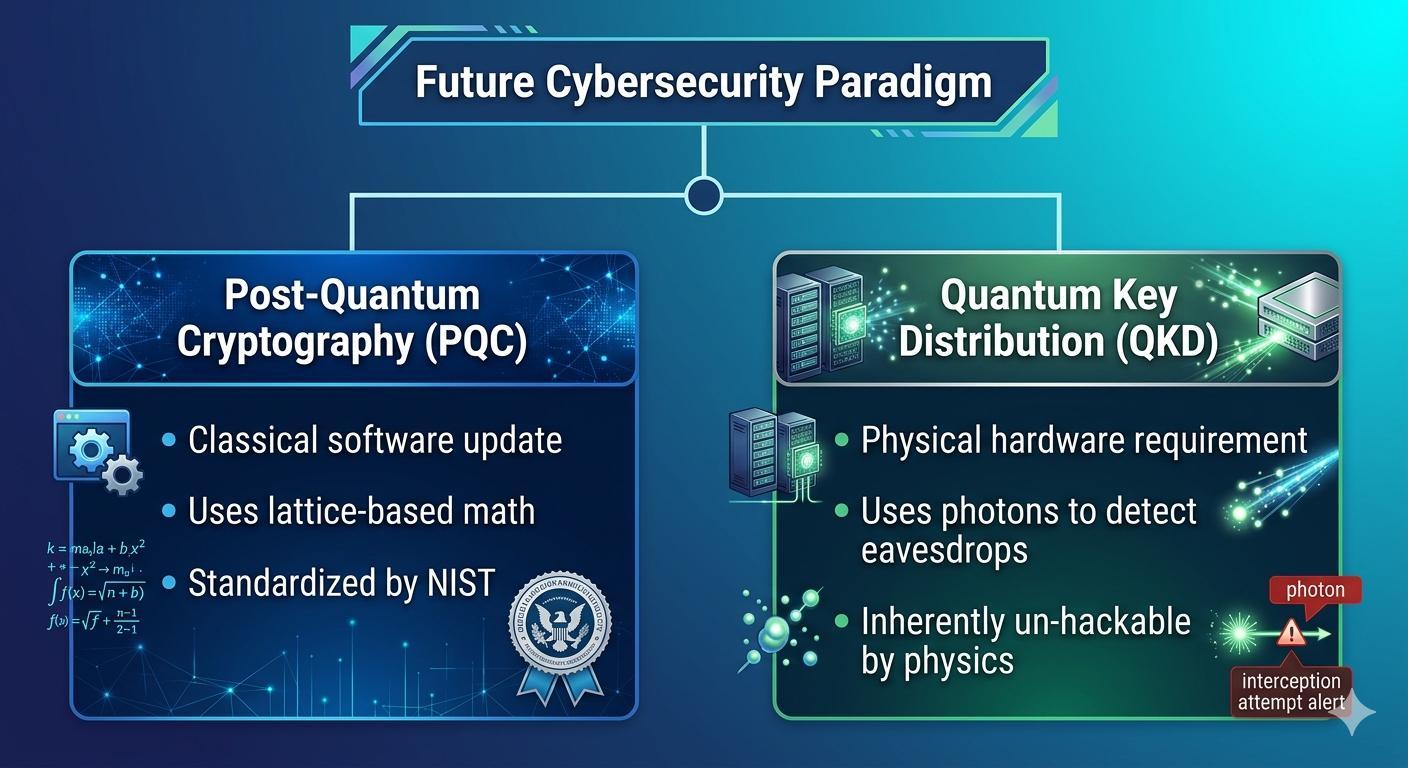
Post-Quantum Cryptography refers to cryptographic algorithms designed to remain secure against both classical and future quantum computers. Unlike Quantum Key Distribution (QKD), PQC does not require specialized quantum hardware. Instead, it can be implemented using conventional computers, making it practical for widespread adoption.
After years of global research and evaluation, the National Institute of Standards and Technology (NIST) selected new cryptographic standards to support the transition into the quantum era. Some of the most important standardized algorithms include:
- ML-KEM (formerly CRYSTALS-Kyber) – A key encapsulation mechanism intended to replace vulnerable public-key key exchange methods.
- ML-DSA (formerly CRYSTALS-Dilithium) – A digital signature algorithm designed for authentication and software signing.
- SLH-DSA (formerly SPHINCS+) – A stateless hash-based signature algorithm offering an alternative approach for high-security environments.
These algorithms are expected to gradually replace RSA, ECC, and classical Diffie–Hellman in future systems.
35. Enterprise Migration and Crypto Agility
Migrating to quantum-resistant cryptography is not a single software update—it is a long-term organizational project. A typical migration strategy includes:
Organizations must first identify where cryptography is used across applications, cloud services, VPNs, certificates, APIs, IoT devices, and identity systems. This process, often called a crypto inventory, helps security teams understand which systems require future upgrades.
During the transition period, many organizations are expected to deploy hybrid cryptography, where classical algorithms and post-quantum algorithms operate together until confidence in the new standards is fully established.
36. Impact Across Critical Industries
Quantum security is relevant to nearly every sector that depends on long-term confidentiality and digital trust. Some of the most affected industries include:
- Banking and Financial Services – Secure transactions, payment systems, and customer authentication.
- Cloud Computing – Identity management, encrypted storage, and API security.
- Government and Defence – Classified communications, national infrastructure, and digital identity.
- Healthcare – Long-term protection of patient records and medical research.
- Telecommunications – Network authentication and secure communication channels.
- IoT and Smart Cities – Device identity, firmware integrity, and secure machine-to-machine communication.
- Blockchain and Cryptocurrency – Digital signatures, wallet security, and transaction authentication.
Although each sector faces different risks, the common requirement is a gradual transition toward quantum-resistant cryptographic systems.
37. Security Operations in the Quantum Era
The adoption of post-quantum cryptography will also influence Security Operations Centres (SOCs). Future SOC teams will increasingly monitor: cryptographic asset inventories, certificate lifecycle management, legacy algorithm detection, PKI health and migration status, quantum-related threat intelligence, and compliance with post-quantum standards.
Similarly, penetration testers and security assessors will expand their evaluations beyond software vulnerabilities to include: legacy cryptographic algorithms, weak certificate configurations, outdated TLS implementations, SSH and VPN cryptographic settings, key length assessments, and readiness for PQC migration.
This reflects a shift from simply finding vulnerabilities to evaluating an organization's long-term cryptographic resilience.
38. Looking Ahead
Quantum computing is expected to influence cybersecurity for many years, extending beyond cryptography alone. Emerging areas of research include:
- Quantum Internet – Networks capable of transmitting quantum information.
- Quantum Key Distribution (QKD) – A communication method that uses quantum mechanics to detect eavesdropping.
- Quantum Cloud Computing – Cloud-based access to quantum processors for research and specialized workloads.
- AI-Assisted Quantum Security – Combining artificial intelligence with quantum-safe security monitoring and automation.
- Quantum-Safe Enterprise Architecture – Designing systems that remain secure throughout the transition to post-quantum technologies.
Although practical large-scale quantum computers remain an engineering challenge, organizations are already adopting a proactive approach to ensure today's security decisions remain effective in the future.
Part 5 — Quantum Threat Model: Identifying High-Risk Sectors in the Quantum Era
39. Understanding the Quantum Threat Model
A threat model helps organizations identify which assets require protection, who the potential adversaries are, and how emerging technologies may introduce new security risks.
In the context of quantum computing, the primary concern is not that quantum computers will suddenly compromise every encrypted system. Instead, the risk lies in the possibility that future fault-tolerant quantum computers could weaken cryptographic algorithms currently used to establish trust, authenticate identities, and protect sensitive communications.
Organizations should therefore evaluate where cryptography is used, how long protected data must remain confidential, and what operational impact a cryptographic failure would have. This proactive assessment allows security teams to prioritize migration efforts and allocate resources effectively.

40. Critical Attack Surface Analysis
A. Banking and Financial Services
Banks rely heavily on cryptographic technologies to secure online banking, payment gateways, digital signatures, customer authentication, and interbank communication. A successful compromise of public-key cryptography could undermine transaction authenticity and trust in financial systems. For this reason, financial institutions are among the earliest adopters of post-quantum migration strategies.
B. Cloud Computing
Cloud providers secure billions of daily connections through TLS, identity management systems, API authentication, encrypted storage, and certificate infrastructures. Because cloud services support organizations across multiple industries, migrating cloud platforms to quantum-resistant cryptography is expected to have a broad impact on global cybersecurity.
C. Government and Defence
Government agencies manage highly sensitive information that often requires confidentiality for decades. Examples include: national identity systems, diplomatic communications, intelligence reports, critical infrastructure, and military operations. The long lifespan of this information makes government and defence sectors particularly concerned about Harvest Now, Decrypt Later (HNDL) scenarios.
D. Healthcare
Medical records often remain sensitive throughout an individual's lifetime. Hospitals and healthcare providers also depend on secure communication between medical devices, electronic health record systems, and cloud-based healthcare platforms. Protecting this data against future cryptographic threats is becoming an increasingly important security objective.
E. Internet of Things (IoT)
Modern IoT ecosystems include: smart sensors, industrial controllers, connected vehicles, wearable devices, and smart home equipment. Many of these devices operate with limited processing power and memory, making the deployment of new cryptographic algorithms more challenging. Manufacturers must balance strong security with hardware constraints.
F. Smart Cities
Smart city infrastructure integrates transportation systems, surveillance networks, utility management, traffic control, and public services through interconnected digital platforms. As cities become increasingly connected, ensuring that these systems can transition to quantum-resistant security will be essential for maintaining operational resilience.
G. Satellites and Space Infrastructure
Satellite communication supports navigation, weather forecasting, emergency response, military operations, and global telecommunications. Because satellite systems have long operational lifespans and limited opportunities for hardware replacement, planning for future cryptographic upgrades presents unique engineering challenges.
H. Blockchain and Cryptocurrency
Blockchain platforms rely on cryptographic algorithms to validate transactions, authenticate wallet ownership, and maintain network trust. Although blockchain technologies differ in their implementation, many current systems will eventually require migration toward quantum-resistant signature schemes to maintain long-term security.
I. Telecommunications
Telecommunication providers secure large-scale network infrastructure through authentication protocols, encrypted communication channels, and certificate-based trust mechanisms. As global communication networks continue to expand, upgrading these security mechanisms will become an important part of post-quantum preparedness.
J. Artificial Intelligence Systems
Modern AI platforms process large volumes of sensitive information, including proprietary models, training datasets, healthcare records, financial information, and enterprise intellectual property. Although AI itself is not directly threatened by quantum computing, the cryptographic systems used to protect AI infrastructure, APIs, cloud services, and model distribution will eventually require quantum-resistant alternatives.
41. Risk Prioritization
Not every organization faces the same level of quantum-related risk. The priority should be determined by: the sensitivity of stored information, the required confidentiality period, dependence on public-key cryptography, regulatory and compliance requirements, and the ability to update cryptographic infrastructure.
Organizations responsible for protecting information that must remain confidential for many years should begin planning their transition to post-quantum cryptography as early as possible.
- Quantum threats primarily target the cryptographic foundations of digital trust rather than specific industries.
- Banking, cloud computing, government, healthcare, IoT, telecommunications, and blockchain ecosystems are expected to be among the most affected sectors.
- The impact depends on the value of protected data, the lifetime of sensitive information, and the organization's reliance on vulnerable public-key cryptography.
- A structured threat model enables organizations to prioritize migration efforts, reduce long-term risk, and prepare for a gradual transition to quantum-resistant security technologies.
Appendix A — Offensive vs Defensive Comparison
Quantum computing introduces new challenges for existing cryptographic systems while also driving the development of quantum-resistant alternatives. The following comparison highlights common theoretical risks and the corresponding defensive technologies or strategies.
- RSA Factorization — Defensive response: Migrate to ML-KEM / lattice-based cryptography.
- ECC / ECDLP — Defensive response: Migrate to ML-DSA / hash-based signatures.
- Brute-force key search — Defensive response: Increase symmetric key sizes (AES-256).
- Hash collision — Defensive response: Increase hash output lengths (SHA-384, SHA-512).
- HNDL data harvesting — Defensive response: Deploy PQC hybrid modes, prioritize long-lived secrets.
Appendix B — Enterprise Migration Roadmap
Transitioning to Post-Quantum Cryptography is a long-term organizational initiative rather than a simple software upgrade. A structured migration roadmap reduces operational risk while ensuring business continuity.
Roadmap: Asset Discovery → Cryptographic Inventory → Risk Assessment → Migration Planning → Hybrid Deployment → Testing & Validation → Production Rollout → Continuous Monitoring
Key Migration Activities:
- Identify all cryptographic assets across the organization.
- Locate systems using RSA, ECC, or classical Diffie-Hellman.
- Prioritize applications based on business impact.
- Test quantum-safe algorithms in non-production environments.
- Deploy hybrid cryptographic solutions where appropriate.
- Monitor compatibility, performance, and operational stability.
- Gradually replace legacy cryptographic implementations.
Appendix C — Security Operations Center (SOC) in the Quantum Era
The transition to quantum-safe cryptography will expand the responsibilities of modern Security Operations Centers.
SIEM — Security Information and Event Management platforms will increasingly monitor cryptographic events, certificate lifecycle changes, and quantum migration status.
Threat Hunting — Threat hunters will identify legacy cryptographic deployments, weak authentication mechanisms, and indicators of "Harvest Now, Decrypt Later" targeting.
Incident Response — Response procedures will include validating cryptographic integrity, reviewing certificate trust chains, and assessing the impact of compromised cryptographic assets.
Threat Intelligence — SOC teams will monitor developments in quantum computing, emerging post-quantum standards, and nation-state adoption of quantum technologies.
Digital Forensics — Future forensic investigations may require verification of post-quantum signatures, certificate histories, and cryptographic evidence integrity.
PKI Monitoring — Continuous monitoring of Certificate Authorities, certificate expiration, algorithm usage, and migration status will become increasingly important.
Certificate Monitoring — Organizations should maintain visibility into certificate inventories and ensure timely replacement of legacy algorithms with quantum-resistant alternatives.
Appendix D — Pentesting in the Quantum Era
The objective of penetration testing is evolving from identifying software vulnerabilities to evaluating an organization's cryptographic readiness. Future assessments may include:
- Crypto Inventory — Identifying where cryptographic algorithms are used throughout the enterprise.
- Certificate Enumeration — Reviewing certificates, key lengths, expiration dates, and signing algorithms.
- TLS Analysis — Assessing supported TLS versions, cipher suites, and readiness for hybrid or post-quantum cryptography.
- SSH Analysis — Evaluating SSH configurations, host keys, and authentication mechanisms.
- VPN Assessment — Reviewing VPN implementations to determine future migration requirements.
- Key Length Assessment — Ensuring cryptographic parameters align with current industry recommendations.
- Legacy Cryptography Detection — Identifying outdated or unsupported cryptographic algorithms that should be replaced during migration planning.
Appendix E — Future Directions
Quantum computing is expected to influence multiple areas of cybersecurity beyond cryptography.
Quantum Internet — A future communication infrastructure capable of transmitting quantum information between geographically separated systems.
Quantum Key Distribution (QKD) — A communication technique that leverages quantum mechanics to detect interception during key exchange. While promising, QKD complements rather than replaces Post-Quantum Cryptography.
Quantum Networking — Research into distributed quantum communication and networking technologies for secure information exchange.
Quantum Cloud Computing — Major cloud providers are already offering access to quantum processors for education, research, and algorithm development through cloud platforms.
Quantum Malware (Conceptual Discussion) — Although no practical quantum malware currently exists, researchers are exploring how future adversaries might integrate quantum computing into offensive cyber operations. At present, this remains a theoretical research topic rather than an operational threat.
Quantum-Safe Enterprise — Organizations are increasingly adopting crypto-agility, hybrid cryptography, and long-term migration planning to prepare for future quantum capabilities.
Artificial Intelligence and Quantum Security — AI and quantum computing are expected to complement each other in areas such as threat detection, cryptographic optimization, security automation, and advanced security analytics.
Appendix F — Research and Standards
The recommendations throughout this article are based on ongoing work by internationally recognized standards organizations, government agencies, technology vendors, and academic researchers.
National Institute of Standards and Technology (NIST) — Leading the global standardization of Post-Quantum Cryptography, including ML-KEM, ML-DSA, and SLH-DSA.
IBM Quantum — Developing scalable quantum hardware, quantum software ecosystems, and enterprise quantum computing research.
Google Quantum AI — Conducting research into quantum processors, quantum algorithms, and fault-tolerant quantum computing.
Microsoft Azure Quantum — Providing cloud-based access to quantum development tools, simulators, and hybrid quantum computing services.
AWS Braket — Amazon's managed quantum computing platform that enables researchers to experiment with multiple quantum hardware providers.
ETSI — The European Telecommunications Standards Institute develops guidance for quantum-safe cryptography and secure communication standards.
NSA – CNSA 2.0 — The U.S. National Security Agency's Commercial National Security Algorithm Suite 2.0 provides recommendations for transitioning national security systems toward quantum-resistant cryptographic algorithms.
ENISA — The European Union Agency for Cybersecurity publishes reports on quantum security risks, migration planning, and cryptographic resilience.
CISA — The Cybersecurity and Infrastructure Security Agency provides guidance on post-quantum readiness, cryptographic inventories, and organizational migration planning.
Final Thoughts
The transition to a quantum-safe future is not solely a technological challenge—it is also an organizational, operational, and strategic transformation. By combining standardized Post-Quantum Cryptography, crypto-agility, continuous monitoring, and proactive migration planning, organizations can strengthen long-term digital trust while preparing for the next generation of computational capabilities.