That little padlock you see in your browser? Or the secure chat you have on your phone? Or even a Bitcoin transaction? Odds are, Elliptic Curve Cryptography (ECC) is behind the scenes, keeping everything safe. ECC isn't just another buzzword — it's powerful because it gives you RSA-level security with way smaller keys. We're talking about a 256-bit ECC key being as tough to crack as a huge 3072-bit RSA key. That's a big deal: smaller keys speed things up, save you bandwidth, and drain less battery — exactly why ECC took over mobile devices, IoT gadgets, and blockchain apps.
So, let's dig into the real math behind ECC to see how the magic works, take a look at where it pops up out in the wild, and then actually get our hands dirty with a little Python demo.
The Curve
At the heart of ECC, you've got a curve. In math-speak, it's defined by an equation like this:
$$y^2 = x^3 + ax + b, \quad \text{where } 4a^3 + 27b^2 \neq 0$$
There's a little catch — a non-zero discriminant condition. This just means the curve can't have cusps or self-intersections, and without that, the whole cryptographic magic fizzles out. If there's a funky point (like a loop or a sharp edge), the group structure we're about to lean on falls apart.
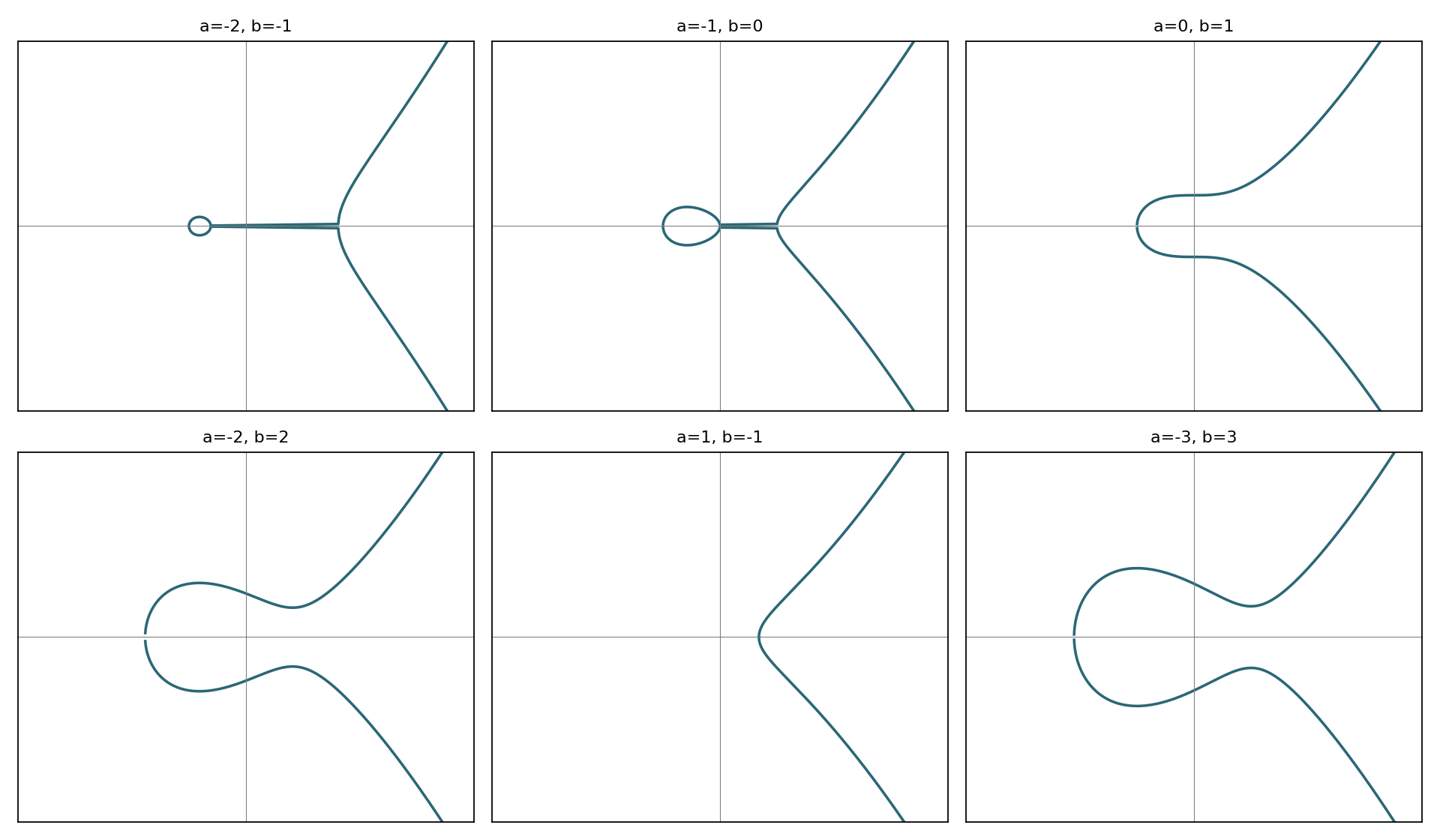
The cool thing isn't so much the curve itself, but a rule for combining points on the curve. If you "add" two points, you get another point on the curve. That simple rule turns the curve into a group: it has closure, an identity element (think "point at infinity," $\mathcal{O}$), and every point is its own inverse if you flip it over the x-axis.
Point Addition and Doubling
There's actually a nice geometric way to see this: take two points, draw a straight line through them. That line is going to hit the curve at exactly one more spot. Flip that third spot across the x-axis and boom, that's your answer for the "sum" of the two points.
And if you're adding a point to itself, you just draw the tangent at that point (so basically, follow the curve as it bends) and do the same thing: see where it hits again, and flip across the x-axis.
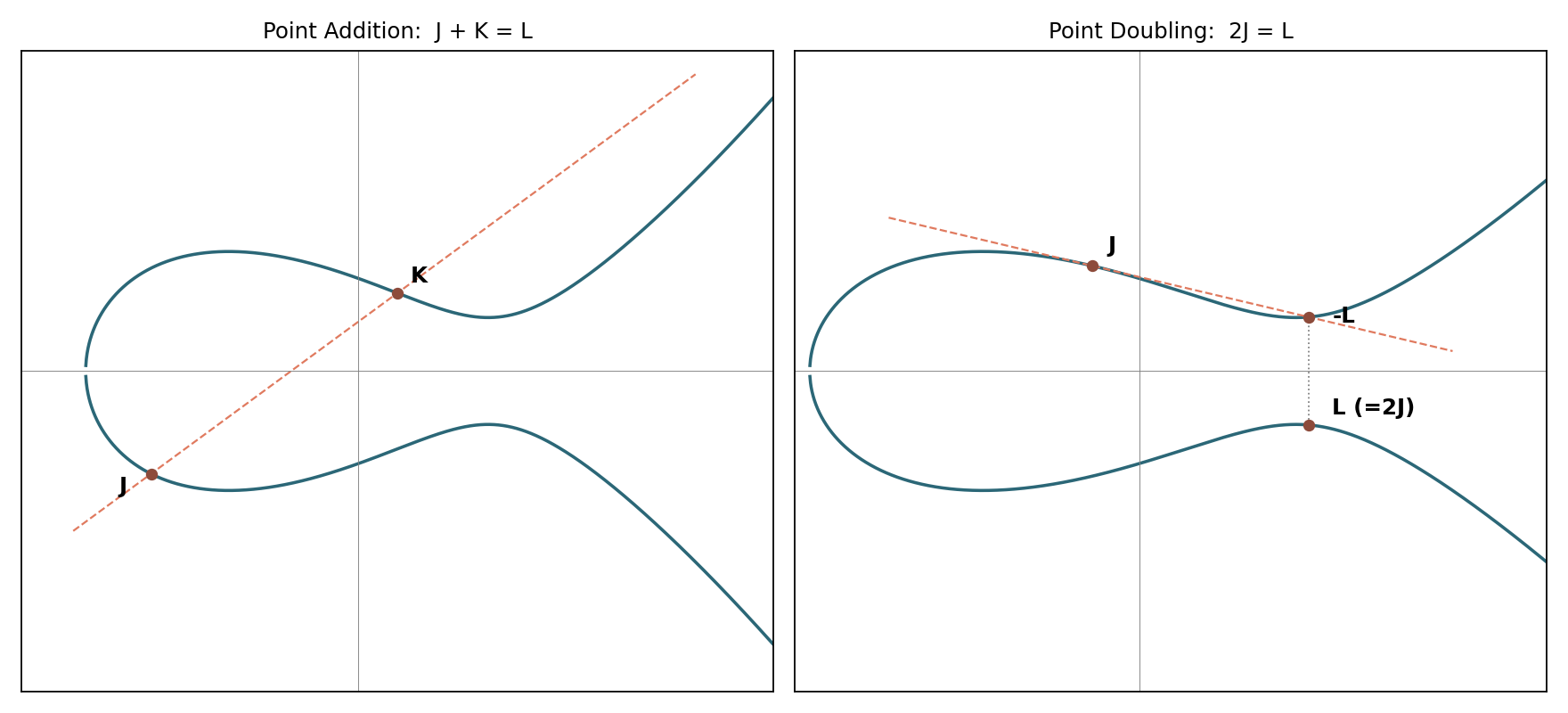
Dig into the math a bit, and you get some formulas for both different-point addition and the point-doubling case. Don't worry, the principle is always the same: draw lines, find intersections, reflect, repeat.
For addition of two distinct points $J=(x_J,y_J)$ and $K=(x_K,y_K)$:
$$s = \frac{y_J - y_K}{x_J - x_K}, \qquad x_L = s^2 - x_J - x_K, \qquad y_L = -y_J + s(x_J - x_L)$$
And for doubling a point $J$ (where $y_J \neq 0$), using the tangent line instead of a secant:
$$s = \frac{3x_J^2 + a}{2y_J}, \qquad x_L = s^2 - 2x_J, \qquad y_L = -y_J + s(x_J - x_L)$$
Now, when you see someone write $kP$, what they're really doing is adding the point $P$ to itself $k$ times — sort of like multiplication by repeated addition in basic arithmetic. There's a fast way to do this called "double-and-add," which is exactly as it sounds: you keep doubling and adding so you don't have to tediously add $P$ over and over. For example:
$$23P = 2\big(2(2(2P) + P) + P\big) + P$$
The Hard Problem
Why does any of this matter? Because it's really easy to move forward — multiply a point by a number — but given two points $P$ and $Q = kP$, it's basically impossible (with current tech) to find $k$ when it's large. This one-way street is called the Elliptic Curve Discrete Logarithm Problem (ECDLP), and it's the whole reason ECC works.
When you get down to actual use, these curves aren't drawn over real numbers (those would be way too slow and imprecise) but over finite fields. Usually, that's either all the numbers from 0 up to some big prime $p$ (with math done modulo $p$, written $GF(p)$), or binary fields $GF(2^m)$. Security standards spell out curves in detail, with key sizes running from 112 up to 521 bits.
Key Exchange: ECDH
The classic way ECC shows up is in Diffie-Hellman-style key exchange (ECDH). Both sides agree on a curve $E_q(a,b)$ and a big base point $G$ of order $n$. Then:
- Each person picks a secret (a random number $n_A$ or $n_B$, less than $n$) and multiplies it by the base point to get a public value: $P_A = n_A \times G$ and $P_B = n_B \times G$.
- They swap public values.
- Each multiplies their own secret by the other's public value.
$$K = n_A \times P_B \quad \text{(computed by A)} \qquad K = n_B \times P_A \quad \text{(computed by B)}$$
Both sides land on the exact same shared secret, $K = n_A n_B G$. But someone listening in? To break it, they'd have to solve that near-impossible ECDLP using only $G$, $P_A$, and $P_B$.
If you want to actually encrypt something, you can use a similar approach. To send a message $P_m$ (encoded as a curve point), A picks a random $k$ and sends the ciphertext pair $C_m = \{kG,\ P_m + kP_B\}$. The other side can recover the message using their secret: $P_m + kP_B - n_B(kG) = P_m$.
Where ECC Lives
ECC isn't just some theoretical trick — it's running just about everywhere:
- Browsers: Modern web browsers use ECDHE (the EC version of Diffie-Hellman) on curves like
secp256r1(also called P-256). This gives you fast, secure SSL/TLS handshakes and forward secrecy. - Cryptocurrencies: Bitcoin and Ethereum both use
secp256k1for digital signatures. Your wallet's secret key is just a random 256-bit number, and the public address is just a curve point multiplied out. - Messaging apps: Signal and WhatsApp go with
Curve25519(for X25519 key exchange). It's robust and avoids a bunch of tricky implementation pitfalls. - SSH & code signing: Ed25519, based on Curve25519, is now the default for SSH keys and software signing. It's fast and makes for tiny keys and signatures.
Why did ECC win in mobile and embedded stuff? Simple — small keys mean less to store, less to transmit, and way faster arithmetic. On resource-limited devices, that's everything.
Just look at the numbers below. To match the security of a 256-bit symmetric key, you'd need a monster 15,360-bit RSA key — or just a 512-bit ECC key. ECC's gap only grows as you crank up security.
| Symmetric key (bits) | ECC key size (bits) | RSA/DSA modulus (bits) |
|---|---|---|
| 56 | 112 | 512 |
| 80 | 160 | 1024 |
| 112 | 224 | 2048 |
| 128 | 256 | 3072 |
| 192 | 384 | 7680 |
| 256 | 512 | 15360 |
Try It Yourself: A Toy ECC Implementation
Here's a stripped-down but fully working piece of Python that does ECC over a tiny prime field. It covers adding points, doubling, scalar multiplication, and even a full ECDH key exchange, all in about 30 lines.
from dataclasses import dataclass
import random

@dataclass
class Curve:
    a: int
    b: int
    p: int   # prime modulus

    def is_on_curve(self, point):
        if point is None:
            return True
        x, y = point
        return (y * y - (x**3 + self.a * x + self.b)) % self.p == 0

def inverse_mod(k, p):
    return pow(k, -1, p)

def point_add(curve, P, Q):
    if P is None: return Q
    if Q is None: return P
    x1, y1 = P
    x2, y2 = Q
    p = curve.p
    if x1 == x2 and (y1 + y2) % p == 0:
        return None
    if P == Q:
        s = (3 * x1 * x1 + curve.a) * inverse_mod(2 * y1, p) % p
    else:
        s = (y1 - y2) * inverse_mod(x1 - x2, p) % p
    x3 = (s * s - x1 - x2) % p
    y3 = (-y1 + s * (x1 - x3)) % p
    return (x3, y3)

def scalar_mult(curve, k, P):
    result = None
    addend = P
    while k:
        if k & 1:
            result = point_add(curve, result, addend)
        addend = point_add(curve, addend, addend)
        k >>= 1
    return result

curve = Curve(a=2, b=3, p=97)
G = (0, 10)
assert curve.is_on_curve(G)

n_A = random.randint(1, 49)
n_B = random.randint(1, 49)
P_A = scalar_mult(curve, n_A, G)
P_B = scalar_mult(curve, n_B, G)
K_A = scalar_mult(curve, n_A, P_B)
K_B = scalar_mult(curve, n_B, P_A)
print(f"A's private: {n_A}, public: {P_A}")
print(f"B's private: {n_B}, public: {P_B}")
print(f"Shared secret matches: {K_A == K_B}  -> {K_A}")
Go ahead, run this! Both sides will agree on the same shared point. That's the whole point of ECDH, and it's really that simple. Plug in a real 256-bit curve under the hood, and the logic is pretty much identical to what secures your browser sessions today.
Takeaway
ECC isn't some wild cryptographic voodoo. It's classic algebra — groups built out of drawing lines on curves — mixed with a genuinely hard math problem (the ECDLP). That combo just happens to be efficient enough for your watch and strong enough for blockchains. Next time you see that padlock, remember: somewhere, a tiny, elegant piece of number theory just made your life a lot more secure.