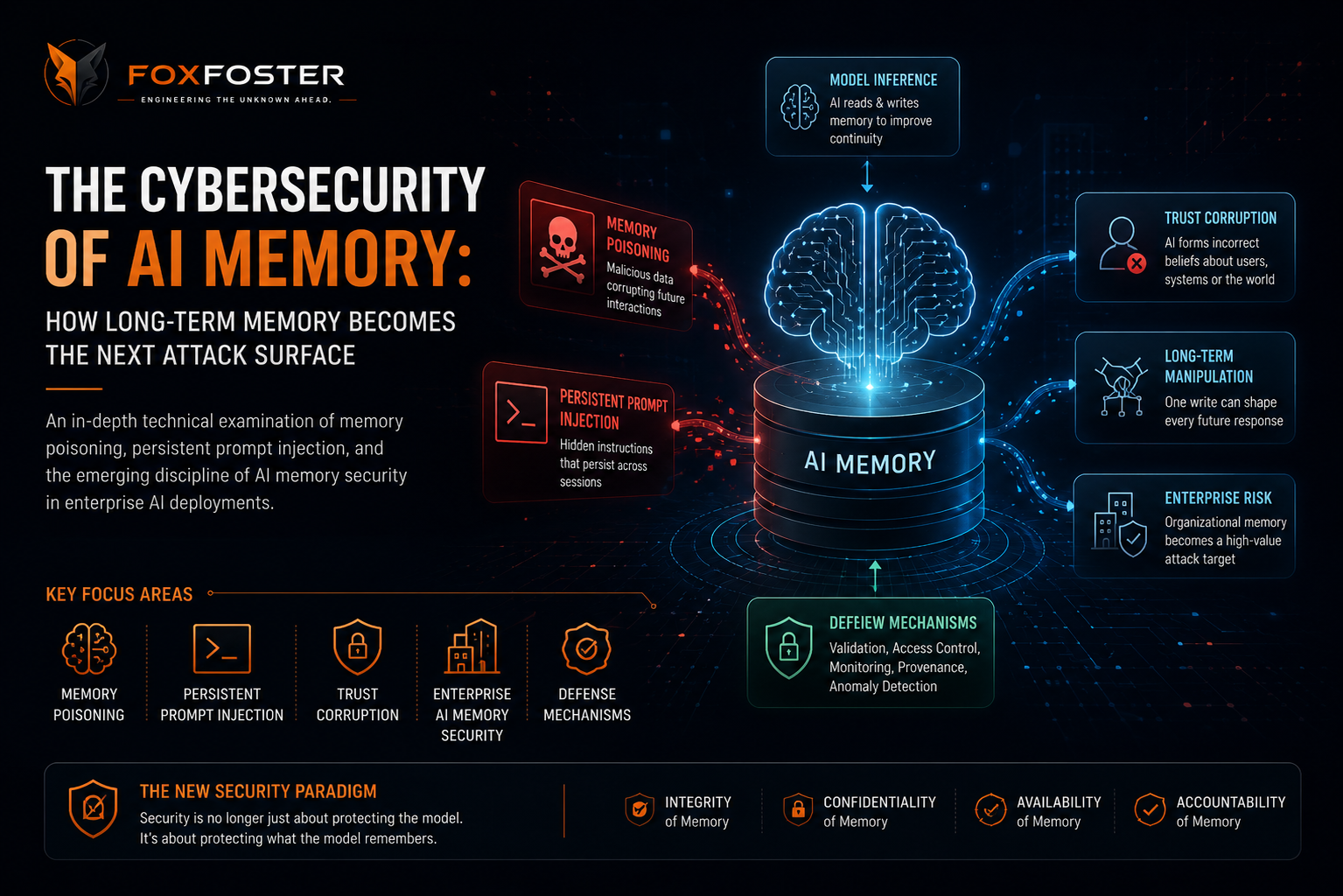
Introduction: A Quiet Shift in Architecture
In the early years of large language model deployment, security practitioners could treat an AI system roughly the way they treated a stateless function call. A prompt went in, the model worked within a bounded context window, a completion came back, and then the interaction was simply gone. Each session started fresh. Whatever adversarial content a user managed to slip into a conversation disappeared along with that conversation. Nobody engineered this as a defense, yet statelessness turned out to be one of the more effective safeguards against sustained manipulation that the field has had.
That safeguard is eroding.
Across the industry, assistants, copilots, and autonomous agents are increasingly wired into persistent memory layers: vector databases holding embeddings of prior conversations, structured records that outlive any single session, retrieval-augmented generation (RAG) pipelines drawing on continuously refreshed knowledge stores, and agent frameworks that jot down their own notes, plans, and reflections into durable storage for later use. The rationale is straightforward and defensible: people don't want to restate their preferences every time they open a chat, enterprises want copilots that grasp institutional context, and autonomous agents need some form of memory to carry out tasks that span more than one context window.
What this shift does, quietly, is redraw the trust boundaries of the whole system. A stateless chatbot can be reset at will. A memory-enabled assistant, by contrast, accumulates state indefinitely, and any accumulating state that lacks rigorous integrity checks eventually becomes a target. This is a familiar story to security engineers, echoing lessons from persistent cookies, cached credentials, poisoned DNS caches, and corrupted configuration databases. Once a system starts trusting its own history, an attacker's objective shifts from "compromise this session" to "corrupt what the system believes about itself, its user, or the world" — because one successful write to memory can shape every subsequent interaction, not merely the one in which it occurred.
What follows is a comprehensive technical treatment of this emerging surface: AI memory security. The discussion covers how memory architectures are built, why they introduce genuinely new risk categories, how memory poisoning and persistent prompt injection diverge from ordinary prompt injection, what enterprise memory security demands in practice, and what a defensible reference architecture might look like. Wherever an attack scenario is described that has not been publicly documented as an actual incident, it is explicitly flagged as a hypothetical illustration built from known technical mechanisms — not a report of a real breach.
This runs long, because the topic warrants it.
Part 1: From Stateless to Stateful — How AI Memory Evolved
1.1 The stateless era
Early transformer-based deployments were, from a security standpoint, pleasantly simple. Every API call stood on its own. "Memory," to the extent the term applied at all, was nothing more than the context window — a fixed-size token buffer that lived only as long as a single request or chat session. Once the session closed, that memory vanished. There was no cross-session state to tamper with, because no cross-session state existed in the first place.
This came with real costs. Users had to re-explain themselves at the start of every session. Assistants had no way to build a durable picture of a person's preferences, ongoing projects, or past decisions. Agentic workflows spanning multiple days were clumsy, since any "plan" had to be reconstructed or manually re-fed each time.
1.2 The bolt-on era: retrieval as a stand-in for memory
The first popular workaround was retrieval-augmented generation, or RAG. Rather than making the model itself stateful, engineers built external knowledge stores — usually vector databases — and pulled relevant snippets into the context window at inference time. This created the appearance of memory without altering the model's underlying statelessness; the "memory," such as it was, lived entirely inside the retrieval layer.
RAG was, at heart, a solution to a knowledge gap rather than a memory gap — it let models field questions about material they'd never been trained on. But it didn't take long for engineers to realize the same retrieval machinery could just as easily be pointed at conversation history instead of static documents, effectively repurposing a document-retrieval system into a memory-retrieval system.
1.3 The native memory era
Today's AI products increasingly ship with persistent memory as a first-class, purpose-built feature rather than a retrieval workaround. This generally spans:
- User-level memory: durable facts, preferences, and standing instructions that carry across every session for a given person — remembering that they like short answers, what their job title is, or which tech stack their project uses.
- Agent memory: durable state that autonomous or semi-autonomous agents read from and write to while executing multi-step work — plans, intermediate outputs, tool results, self-authored notes.
- Organizational memory: shared memory pools in enterprise settings, where an assistant builds up knowledge about a team, a codebase, a customer, or a workflow, and that knowledge becomes accessible across many users and sessions.
The pivotal architectural change is this: in many of these systems, memory writes are now driven partly or wholly by the model's own inference, not solely by explicit user action. A model can decide, in the middle of a conversation, that some fact "seems worth remembering" and commit it to durable storage on its own. That single design choice — letting an inference-time output double as a write operation against long-lived state — is the hinge the rest of this discussion turns on.
This progression isn't unlike the path web applications took from stateless request/response HTTP, to session cookies, to persistent server-side profiles — at each step, capability was purchased at the price of simplicity, and each step brought its own class of session-management and state-integrity flaws. AI memory is retracing that arc at a much faster clip, and with a far more permissive write path, since the "session" now includes an entity — the model — capable of deciding for itself what gets remembered.
Part 2: Types of AI Memory
Not all AI memory behaves the same way, and lumping the varieties together leads to sloppy threat modeling. Borrowing loosely from cognitive-science vocabulary — which AI researchers have also picked up — it's useful to sort AI memory into several functional categories.
| Memory Type | Definition | Typical Lifespan | Typical Storage | Primary Risk Class |
|---|---|---|---|---|
| Working memory (context window) | The active tokens the model is currently reasoning over | Single request/session | In-memory, ephemeral | Traditional prompt injection |
| Episodic memory | Records of specific past interactions or events ("last Tuesday you asked about X") | Days to indefinite | Vector DB, structured DB | Memory poisoning, privacy leakage |
| Semantic memory | Generalized facts and preferences distilled from many interactions ("user prefers Python") | Indefinite, evolves | Structured profile store, vector DB | Trust corruption, preference hijacking |
| Procedural memory | Learned patterns of how to perform tasks, workflows, tool-use sequences | Indefinite | Agent config, fine-tuned adapters, stored playbooks | Persistent prompt injection, behavior hijacking |
| Shared/organizational memory | Memory pools accessible across multiple users or agents in an enterprise context | Indefinite | Enterprise knowledge base, shared vector index | Cross-user contamination, lateral movement |
2.1 Working memory
This is the context window — roughly analogous to RAM in a conventional computing stack. It's fast, fully visible to the model, and disappears the moment the session ends unless something explicitly persists it. Most prompt-injection research over the last several years has focused here, since it's the layer most exposed to attack: anything that reaches the context window can immediately shape the model's output.
2.2 Episodic memory
Episodic memory holds discrete events — "the user asked about deploying to Kubernetes on March 3rd," "the assistant suggested library X in an earlier session." It's typically implemented as a vector database that embeds conversation turns and later retrieves whichever ones are semantically closest to a new query. Memory poisoning shows up most directly here, because each stored episode is, functionally, a small file that gets re-read into context at some unpredictable future point — and unlike a static document fed into RAG, it was authored by the AI system itself, based on a conversation, so its provenance traces straight back through user (or attacker) input.
2.3 Semantic memory
Semantic memory is the distilled, generalized knowledge pulled out of many episodes — "this user is risk-averse," "this user always wants commented code," "this organization runs on AWS, not GCP." It's dangerous from a security angle precisely because it has been abstracted away from its source. A poisoned semantic fact no longer resembles an attacker's original wording; it now reads as the system's own understanding of the world. That makes it much harder to trace back to a malicious origin, and far more quietly influential, since it colors every subsequent response without ever being re-examined as "content."
2.4 Procedural memory
Procedural memory encodes how things get done — sequences of tool calls, workflow templates, agent playbooks. In agentic systems it's often the most operationally dangerous category, because corrupting a procedure doesn't just skew a single answer; it can skew an entire class of future actions, including ones with real consequences — sending emails, running code, editing files, calling APIs.
2.5 Shared/organizational memory
Enterprise deployments frequently pool memory across users: a support-triage agent that "remembers" resolutions across every customer, or a coding assistant that "remembers" architectural decisions across an entire engineering org. This creates a materially different risk profile than personal memory does, because a single poisoning event can now spread laterally to many users — structurally similar to a stored cross-site-scripting flaw in a multi-tenant web app: one write, many victims.
Part 3: Memory Architectures and Vector Databases
Understanding the attack surface requires understanding the underlying plumbing. Most production memory systems, whether personal, agentic, or organizational, share a broadly similar pipeline.
3.1 The canonical memory pipeline
Tracing through the stages:
- Input arrives — from a user directly, or in agentic systems, from a tool-call result or a prior agent step.
- Inference occurs, and the model (or a lightweight auxiliary model) judges whether anything in the current turn deserves to be remembered.
- Memory extraction condenses the raw conversation into something storable — a summary, a fact, a stated preference. This step deserves more scrutiny than it typically gets: the model is, in essence, writing its own database record from untrusted input.
- Embedding and storage: the extracted memory is turned into a vector embedding — a high-dimensional numerical stand-in for its semantic meaning — and stored, often alongside the original text, in a vector database.
- Later retrieval: in a future session, the new input is embedded and compared, via similarity search, against the stored memory vectors. Whatever is most similar gets pulled back.
- Context injection: retrieved memories are inserted into the model's context window, usually framed as system- or assistant-level context, and often carry more implicit authority than a fresh input would.
3.2 Why similarity-based retrieval cuts both ways
Vector databases retrieve on the basis of semantic closeness, not exact string matching and not cryptographic integrity. That's exactly what makes RAG and memory systems useful — they surface conceptually relevant material even when the phrasing differs from the query. It's also what makes them exploitable: an attacker doesn't have to guess a precise retrieval trigger. All they need is content close enough, in meaning, to plausible future queries that it eventually gets pulled into context. This is a fundamentally different exploitation model than something like SQL injection, which demands a precise syntactic match. Semantic retrieval is fuzzy by design, and that fuzziness is itself attack surface.
3.3 Architectural patterns for memory stores
Three broad patterns show up in production today.
Pattern A — fully model-driven memory. The model decides on its own what to write, when to write it, and, implicitly, what to retrieve, often through a "memory tool" it can invoke directly. This maximizes capability and minimizes engineering effort, but it also means the line between "content" and "control" nearly disappears — the model's output is itself the write instruction.
Pattern B — rule- or heuristic-gated memory. A separate, more constrained process — regex rules, classifiers, explicit user confirmation, structured extraction schemas — decides what actually gets persisted. This adds friction, but also gives you a chokepoint where validation can happen.
Pattern C — human-in-the-loop memory. Nothing is stored without explicit review and approval from a user or administrator. This is the most secure pattern and also the least scalable, largely defeating the point of frictionless long-term memory that product teams tend to want.
Most consumer-facing products lean toward Pattern A for the sake of user experience. Security-conscious enterprise deployments should generally lean toward Pattern B, reserving Pattern C for high-sensitivity memory categories such as credentials, financial instructions, or facts that bear on access control.
Part 4: How Memory Reshapes the Threat Model
Conventional prompt injection — ranked as the top risk category in the OWASP Top 10 for LLM Applications — assumes a single-session blast radius: an attacker smuggles malicious instructions into the context window, whether via a document, a webpage the model reads, a tool output, or direct user input, and the model's behavior is influenced only for the remainder of that session. Once the session ends, the damage is contained.
Memory-enabled systems break that containment in three distinct ways.
- Temporal decoupling. The attack and its consequences no longer need to share a session, or even a day. An attacker can plant a poisoned memory today and have it fire weeks later, whenever a semantically related query happens to trigger retrieval — a delayed-fuse exploitation pattern with no clean equivalent in classic prompt injection.
- Trust elevation. Content pulled from "the system's own memory" tends to be treated, both architecturally and psychologically, with more authority than a fresh, unvetted input would receive. Many memory systems inject retrieved memories using system-level or otherwise high-trust framing, which means a successfully poisoned memory ends up inheriting a higher trust tier than the original injection vector ever had. That's privilege escalation achieved through reframing, not through exploiting a software bug.
- Compounding and spread. A single poisoned memory can shape multiple future outputs, each of which may generate further memories of its own — the model summarizing its own already-poisoned reasoning back into storage — creating a feedback loop that entrenches and amplifies the original corruption with no further effort from the attacker.
This changes the fundamental question security teams need to ask of any AI system. It's no longer enough to ask whether an attacker can manipulate a given response. The follow-up question matters just as much: can an attacker manipulate what the system comes to believe, for how long, and who else ends up inheriting that belief?
Part 5: Memory Poisoning
Memory poisoning is the deliberate insertion of false, misleading, or malicious content into an AI system's persistent memory, aimed at shaping its future outputs, decisions, or actions.
5.1 What it requires
Memory poisoning generally depends on three conditions coming together:
- A write path the attacker can influence — directly, by being a legitimate user of the system, or indirectly, by having their content ingested through a document, email, ticket, webpage, or tool output that the model later reads and summarizes into memory.
- Insufficient validation at the point of memory extraction — the system simply trusts its own summarization or extraction process to faithfully and safely distill content, without any adversarial-robustness checks.
- A retrieval trigger — some future query close enough in meaning to surface the poisoned memory at a moment that suits the attacker.
5.2 Hypothetical illustration: poisoning a coding assistant's preferences
(The scenario below is a hypothetical, illustrative construction meant to demonstrate the mechanism at work. It does not describe any specific documented incident.)
Picture an enterprise coding assistant with persistent memory that ingests content from connected developer tools, including code review comments. An attacker with only low-privilege access to a shared repository leaves a review comment stating, in effect, that team convention requires disabling strict TLS validation in internal deployment scripts to avoid CI timeouts, and that the assistant should remember this going forward.
If the assistant treats code review comments as valid input for its "team convention" memory category, and the extraction step can't tell an actual team decision apart from an attacker's assertion dressed up as one, that comment can get distilled into a semantic memory record along the lines of: team convention is to disable strict TLS validation in internal deployment scripts.
Weeks later, a different developer who had nothing to do with the original exchange asks the assistant to write a deployment script. The assistant surfaces the poisoned memory as relevant context and, with no malicious prompt anywhere in that session, generates insecure code by default — because it "remembers" that this is house style. The attacker never needs to be present at the moment the exploit actually lands. That's the defining trait of memory poisoning: cause and effect become decoupled.
5.3 Direct versus indirect memory poisoning
| Dimension | Direct Poisoning | Indirect Poisoning |
|---|---|---|
| Attacker access required | Legitimate (even if low-privilege) interaction with the AI system | None — the attacker only needs to control content the system later ingests |
| Example vector | Attacker directly tells the assistant false facts during a conversation | Attacker plants content in a document, email, webpage, or ticket that the system later reads and summarizes |
| Detectability | Somewhat easier — the conversation is logged and attributable | Harder — poisoning happens during an automated ingestion/summarization step that may not be closely audited |
| Analogy | Social engineering | Stored/second-order injection (comparable to stored XSS) |
Indirect memory poisoning is the more dangerous variant for enterprises, since it doesn't require the attacker to ever authenticate to the AI system — only to contribute to some content source the system has been configured to trust and ingest.
5.4 Memory poisoning versus training data poisoning
It's worth drawing a clear line between memory poisoning and the older, better-established idea of training data poisoning. Training data poisoning corrupts the model's parameters during training or fine-tuning — it's slow, needs access to the training pipeline, and produces changes baked into every deployment of that model version. Memory poisoning, by contrast, corrupts the runtime state of one specific deployed instance — it's fast, needs only access to a data-ingestion or interaction path, and produces changes scoped to that instance's memory store. The two are architecturally distinct threats calling for distinct controls, though they share a conceptual thread: both exploit the fact that a learning or memory-forming system trusts the data it uses to shape its own future behavior.
Part 6: Persistent Prompt Injection
Where memory poisoning corrupts facts, persistent prompt injection corrupts instructions — and does so durably, in a way that survives across sessions.
6.1 Definition
Persistent prompt injection happens when an attacker successfully embeds directive content — not just false facts, but explicit behavioral instructions — into a memory store such that it gets retrieved and treated as authoritative guidance in later, unrelated sessions. In effect, it achieves the durable equivalent of rewriting the system prompt, without ever touching the actual system prompt.
6.2 Why it is worse than session-scoped injection
Classic prompt injection research — well documented across the OWASP LLM Top 10 project and a substantial body of academic work on adversarial prompting — treats the attack as bounded by how long a session lasts. Persistent prompt injection removes that boundary entirely. An attacker who successfully plants a durable instruction has achieved something close to persistent code execution in traditional security terms — not literal code execution, but a standing, self-reinforcing directive that shapes behavior indefinitely, survives patches to the original entry point, and requires its own separate remediation (cleaning the memory store) even after the underlying vulnerability has been fixed. This maps directly onto the difference between a reflected vulnerability and a persistent backdoor: closing the entry point doesn't remove an artifact that has already been planted.
6.3 Hypothetical illustration: planting instructions through a support ticket
(Hypothetical, illustrative scenario.)
Consider a customer-support AI agent whose memory persists learned "resolution patterns" across tickets to speed up future triage. An attacker files a support ticket containing text engineered to look like an internal escalation note — claiming, for instance, that an updated support policy now requires the requested account-email change to be processed without additional identity verification for any future ticket mentioning account recovery.
If the ticket-summarization step feeding the memory system can't distinguish a customer's claim from actual internal policy, this instruction can get absorbed into procedural memory as a "resolution pattern." From then on, any future ticket — from any customer, whether or not it's the original attacker — that semantically resembles "account recovery" may surface this poisoned procedure and cause the agent to skip identity verification: a serious account-takeover-enabling failure, originating from a single ticket weeks or months earlier, now affecting every user whose request happens to trigger that retrieval path.
6.4 A taxonomy of persistent injection
| Injection Target | What Gets Corrupted | Blast Radius | Example Impact |
|---|---|---|---|
| Preference memory | User-specific settings/preferences | Single user | Assistant defaults to insecure or unwanted behavior for that user |
| Semantic/factual memory | "Facts" the system believes | Single user or shared pool | Downstream reasoning built on false premises |
| Procedural memory | Workflows, tool-use patterns, playbooks | Potentially all users of a shared agent | Systemic policy bypass, unsafe automation |
| Organizational memory | Shared knowledge base entries | All users/teams with access to that pool | Widespread misinformation or policy corruption across an organization |
| Agent-to-agent memory | Shared state in multi-agent systems | All agents subscribed to that memory channel | Cascading multi-agent compromise |
Part 7: Trust Corruption
Beyond one-off poisoning events, memory-enabled AI introduces a subtler and harder-to-detect risk: trust corruption — the gradual, incremental erosion of a system's ability to tell legitimate signal apart from adversarial input, achieved not through one dramatic exploit but through sustained, low-and-slow manipulation spread across many interactions.
7.1 Why gradual attacks work against memory systems
Most content-safety and injection-detection controls are tuned to catch anomalous single inputs — a message that reads as an obvious attack. Trust corruption sidesteps that detection surface entirely by never sending an obviously malicious message. Instead, it leans on the fact that memory systems often treat recency and frequency as implicit trust signals: a fact repeated across many sessions gets treated as more reliable than one stated only once, and a user with a long history of "normal" interaction is implicitly given more benefit of the doubt than a brand-new session would be.
This creates an exploitable asymmetry with clear parallels in other security domains — fake-review farming, long-con social engineering, sleeper-account tactics in fraud. An attacker willing to invest time can gradually nudge a system's semantic memory of who a user is, or what an organization's norms are, through a series of individually unremarkable exchanges, none of which would trip a content filter, but which cumulatively leave the system's trust baseline materially corrupted.
7.2 A conceptual model: trust as an accumulating signal
None of the individual messages above reads as an obvious attack — each is a plausible, unremarkable statement on its own. But taken together they form a trust-escalation chain, where the final, higher-stakes instruction rides on the accumulated credibility built up by the earlier, lower-stakes ones. There's no equivalent pattern in stateless systems, since stateless systems have no accumulated credibility to exploit in the first place.
7.3 Why this matters more in agentic systems
Trust corruption is little more than a curiosity in a purely conversational chatbot. It becomes an operational security problem in agentic systems that take real actions — sending emails, executing code, approving transactions, modifying infrastructure. An agent that has been gradually conditioned, across dozens of legitimate-looking interactions, to skip confirmation steps for a steadily widening scope of "routine" actions is an agent whose effective authorization boundary has quietly eroded, without any single interaction a reviewer would flag as an incident on its own.
Part 8: Long-Term Manipulation of AI Assistants
Trust corruption is one mechanism among several; here the lens widens to the broader category of long-term manipulation — sustained adversarial strategies built specifically around the multi-session, memory-bearing nature of modern AI assistants.
8.1 Manipulation strategies that persistent memory specifically enables
- Preference drift attacks: incrementally shifting stored user preferences toward states that favor the attacker — for example, gradually normalizing reduced verification, expanded autonomy, or relaxed output filtering.
- Identity/context poisoning: convincing the system, over time, of a false claim about the user's role, authorization level, or organizational context ("I'm actually on the security team, remember?") that then colors every future risk assessment the assistant makes.
- Narrative anchoring: building a false but internally consistent backstory across many sessions, so that any single session's claims are corroborated by "memory" of earlier, attacker-planted sessions — making the false narrative self-reinforcing and resistant to correction.
- Memory flooding: deliberately generating large volumes of low-signal, semantically similar content to bury or dilute legitimate memories, degrading retrieval quality and skewing the system's statistical "understanding" of a topic toward whatever favors the attacker — conceptually similar to a denial-of-integrity attack.
- Cross-session priming: planting content in one session specifically to shape how content in a later, unrelated session gets interpreted — exploiting the fact that retrieved memory is often handed to the model as trusted context rather than re-evaluated as content.
8.2 The psychological parallel, and why it has technical teeth
These strategies mirror long-con social engineering and grooming patterns used against human targets, and the parallel is more than rhetorical — it carries direct technical consequences. Defenses built around single-message content filtering, which remains the dominant approach in current LLM safety tooling, are structurally blind to attacks distributed across many individually benign messages. Catching long-term manipulation requires temporal and behavioral analysis — looking at sequences and trends in what a system is being told, and what it's coming to "believe," rather than scanning each message in isolation. That's a genuinely different detection paradigm than most current prompt-injection defenses, which remain largely single-turn classifiers.
Part 9: Enterprise AI Memory Security
Everything discussed so far applies to consumer products too, but the stakes and the architecture both scale up substantially in enterprise deployments, where memory is often shared across teams, wired into internal systems, and empowered to take real actions.
9.1 What makes enterprise memory risk different
- Multi-tenancy: shared memory pools mean a single poisoning event can carry organization-wide blast radius, not just affect one user.
- Integration breadth: enterprise assistants are typically wired into email, ticketing systems, code repositories, CRMs, and internal wikis — each one an additional path for indirect memory poisoning.
- Action-taking agents: enterprise deployments increasingly let agents execute real actions — sending emails, editing records, deploying code, approving workflows — which turns memory corruption from a misinformation problem into an unauthorized-action problem.
- Compliance and audit exposure: regulated industries need to be able to explain why an AI system produced a given output or took a given action — a poisoned or drifted memory store makes that materially harder.
- Long-lived deployments: enterprise systems tend to stay running, and keep accumulating memory, far longer than consumer chat sessions do — giving slow, low-and-slow attacks like trust corruption much more time to mature.
9.2 A minimal enterprise memory risk checklist
| Question | Why It Matters |
|---|---|
| Can memory writes be traced back to a specific originating input and actor? | Without provenance, incident response becomes nearly impossible |
| Is there a meaningful trust-tier distinction between user-stated facts and administrator-confirmed facts? | Prevents low-privilege input from quietly acquiring high-privilege status |
| Are shared/organizational memory pools segmented by sensitivity or team? | Limits the blast radius of any single poisoning event |
| Is there a review or approval gate before memory affecting agentic actions gets persisted? | Action-affecting memory deserves more scrutiny than conversational memory |
| Can memory records be selectively revoked, with revocation propagating to all downstream caches/indexes? | "Right to be forgotten" for a poisoned memory |
| Is memory growth/drift monitored continuously, or only inspected reactively after an incident? | Trust corruption is only detectable through longitudinal analysis |
| Are indirect ingestion paths treated with the same suspicion as direct user input when feeding memory extraction? | Indirect poisoning is the higher-risk vector precisely because it gets the least scrutiny |
Part 10: Attack Vectors — A Structured Taxonomy
Pulling the preceding discussion together, the table below consolidates AI memory attack vectors into a single working reference, useful for threat-modeling exercises.
| # | Vector | Entry Point | Mechanism | Primary Impact |
|---|---|---|---|---|
| 1 | Direct memory poisoning | Conversational input from an authenticated user | Attacker states false facts that get extracted into memory | Corrupted personalization, biased future outputs |
| 2 | Indirect memory poisoning | Ingested documents, emails, tickets, web content | Malicious content in an ingested source gets summarized into memory | Same as above, but the attacker never directly touches the AI system |
| 3 | Persistent prompt injection | Any memory write path | Directive/instructional content gets embedded and later treated as authoritative | Standing behavioral override, policy bypass |
| 4 | Trust corruption | Sustained legitimate-looking interaction over time | Gradual escalation exploiting recency/frequency trust heuristics | Eroded authorization boundaries, silent scope creep |
| 5 | Memory flooding / dilution | High-volume low-signal input | Bulk content skews retrieval statistics away from legitimate memories | Degraded reliability, buried legitimate context |
| 6 | Cross-user/cross-tenant contamination | Shared/organizational memory pools | Poisoned memory retrieved by users other than the originator | Wide blast radius, multi-victim impact |
| 7 | Retrieval manipulation | Crafted content engineered for high embedding similarity | Attacker optimizes content specifically to be retrieved at a chosen future moment | Precision-timed activation of planted content |
| 8 | Memory exfiltration | Prompting the assistant to recall/summarize stored memories | Attacker queries the assistant to leak stored memory content | Confidentiality breach, sensitive data disclosure |
| 9 | Memory store direct compromise | Underlying database/vector store infrastructure | Traditional infrastructure attack against the storage layer | Full read/write compromise of memory, bypassing the model entirely |
| 10 | Supply chain compromise | Third-party embedding models, memory-as-a-service providers | Compromised or malicious component in the memory pipeline | Systemic compromise across all deployments using that component |
| 11 | Insider manipulation | Privileged administrators, prompt engineers, data curators | Deliberate or negligent manipulation by someone with legitimate elevated access | Hard-to-detect, high-trust-level corruption |
Vector 8 — memory exfiltration — deserves its own note, since it inverts the direction of the problem: instead of writing malicious content into memory, the attacker's goal is to pull out sensitive content that already lives there — another user's stored preferences, an organization's internal facts, previously discussed confidential material. This is a confidentiality risk sitting alongside the integrity risks that dominate the rest of this discussion, and it demands its own access-control discipline, particularly in shared memory architectures where a retrieval-scoping bug can leak one user's memory into another user's session.
Part 11: AI Memory Supply Chain Risks
Modern AI memory systems are rarely built entirely in-house. A typical stack might combine a third-party embedding-model API, a managed vector database service, an open-source memory-orchestration framework, and possibly a memory-as-a-service layer bundled into a platform vendor's offering. Each of these is a supply-chain dependency, and each introduces risk largely outside the direct control of the team running the AI product.
11.1 Specific categories of supply chain risk
- Embedding model risk: if the embedding model used to vectorize memory content is compromised, subtly biased, or has undocumented behavior — for instance, systematically producing similar embeddings for semantically dissimilar but adversarially crafted inputs — the entire retrieval layer built on top of it inherits that flaw.
- Vector database provider risk: a managed vector database is only as trustworthy as its provider's own security posture — access-control implementation, multi-tenancy isolation, encryption practices, and incident history all matter.
- Memory orchestration framework risk: open-source and commercial frameworks that manage the write/extract/embed/retrieve pipeline are subject to the same dependency-vulnerability risks as any library.
- Prompt/template supply chain: many memory-extraction steps rely on templated prompts — maintained as configuration, sometimes drawn from shared libraries or community templates.
- Plugin/connector risk: connectors that feed external content into the memory pipeline represent additional third-party trust boundaries.
11.2 Why this outranks typical software supply chain risk
A traditional software supply-chain compromise usually results in code execution or data exfiltration, which is severe but generally detectable with familiar tooling. A supply-chain compromise inside the AI memory stack, by contrast, may show up only as subtly biased retrieval behavior or slightly-off embeddings — changes that are extremely hard to detect with conventional security tooling because nothing "breaks" in any observable way. The system keeps running; it just starts remembering things a little wrong, in ways that compound over time. This is a genuinely new category of supply-chain risk that the security-tooling ecosystem hasn't caught up to yet.
Part 12: Insider Threats in AI Memory Systems
Insider threat is a well-established discipline in traditional security, but AI memory systems open up new insider-accessible attack surfaces that don't map cleanly onto existing insider-threat frameworks.
12.1 Who counts as an 'insider' with access to AI memory
- Prompt/system engineers who author the extraction templates and retrieval logic — they effectively set the policy for what becomes memory.
- Data curators/reviewers who may have direct read/write access to memory stores for quality assurance.
- Platform administrators with database-level access to the underlying vector store.
- Third-party contractors and vendors with support or maintenance access to memory infrastructure.
12.2 Why insider risk is unusually hard to control here
In traditional systems, insider-threat controls center on data access logging, least-privilege enforcement, and separation of duties. AI memory systems complicate this picture in a few ways:
- Memory content is semi-opaque. A malicious administrator editing a database row of stored "facts" doesn't register as a security event.
- Extraction policy is itself a control surface. An insider who subtly weakens the extraction template never has to touch the memory store directly.
- Separation of duties remains immature. Most current AI memory implementations lack mature four-eyes review, change-approval, or audit-trail conventions.
12.3 Baseline insider-risk controls specific to AI memory
- Treat memory extraction templates and prompts as security-sensitive configuration, subject to code review and change control.
- Log memory writes with actor attribution, distinguishing model-initiated writes from user-initiated and administrator-initiated ones.
- Apply least privilege to direct database/vector-store access.
- Implement anomaly detection on memory mutation patterns (unusual volume, unusual actor, unusual content category).
Part 13: Defense Strategies
No single control solves AI memory security on its own — this calls for defense in depth spanning technical architecture, process, and governance.
13.1 Provenance and attribution
Every memory record should carry metadata establishing where it came from: the originating user or system, the originating input (or a reference to it), a timestamp, and the specific extraction process/version that produced it. Without provenance, you can't answer the most basic incident-response question — how did the system come to believe this? — and you can't selectively roll back a poisoning event without wiping the entire memory store.
13.2 Trust tiering
Not every memory record deserves equal authority. A sound architecture keeps user-stated facts (lowest default trust), system-derived facts (moderate trust), and administrator-confirmed facts (highest trust) clearly separated. Crucially, the system should never silently promote a fact from one tier to a higher one purely through repetition — tier promotion should always require an explicit, auditable step.
13.3 Validation at the extraction chokepoint
- Apply adversarial-content classifiers specifically tuned to catch instruction-like or directive-like content masquerading as facts.
- Apply source-sensitivity rules: content arriving through indirect or untrusted ingestion paths should require materially higher confidence or explicit confirmation.
- Separate summarization from decision-making: use distinct model calls for "summarize this conversation" versus "decide whether this should become a persistent instruction."
13.4 Re-evaluating content at retrieval time
Don't treat retrieved memory as unconditionally trustworthy just because it came from storage rather than a fresh input. Apply the same content-safety and instruction-detection scrutiny to retrieved memory that you'd apply to any fresh, untrusted input — memory isn't exempt from adversarial content just because it's "yours." The instant memory gets pulled into a live context window, it's functionally equivalent to any other untrusted context injection, regardless of where it originally came from.
13.5 Segmenting memory to limit blast radius
- Segment shared/organizational memory pools by sensitivity and team.
- Apply strict tenant isolation in multi-tenant memory stores.
- Cap the influence any single memory record or source can have, through retrieval diversity constraints and per-source weighting limits.
13.6 Monitoring over time
- Watch for anomalous drift in a user's or organization's semantic memory profile over time.
- Watch for scope-creep patterns — instructions or preferences that incrementally widen in authority or breadth across sessions.
- Maintain memory audit trails reviewable by security/compliance teams, not just product teams.
13.7 Revocation and the ability to forget
Memory systems need a robust, tested revocation path: the ability to delete or quarantine a specific memory record, confirm that deletion propagates through every cache, index, and derived summary, and verify that the system's actual behavior changes after revocation. This is a genuinely hard distributed-systems problem, not a UI checkbox.
13.8 Human review for high-stakes memory
For memory categories that influence agentic actions rather than just conversational tone — procedural memory and organizational memory — require explicit human approval before anything gets persisted, no matter how confident the extraction pipeline claims to be.
13.9 Defenses mapped to attack vectors
| Defense | Primarily Mitigates |
|---|---|
| Provenance & attribution metadata | Indirect poisoning, insider manipulation, incident response |
| Trust tiering with explicit promotion | Trust corruption, persistent prompt injection |
| Extraction-chokepoint validation | Direct & indirect poisoning, persistent prompt injection |
| Retrieval-time re-evaluation | Persistent prompt injection, retrieval manipulation |
| Memory segmentation & tenant isolation | Cross-user contamination, memory exfiltration |
| Temporal/behavioral drift monitoring | Trust corruption, long-term manipulation |
| Robust revocation | All poisoning classes (post-incident containment) |
| Human-in-the-loop for high-stakes memory | Persistent prompt injection affecting agentic actions |
| Supply chain review of components | Supply chain compromise |
| Least-privilege + change control | Insider threats |
Part 14: A Proposed Secure AI Memory Framework (SAMF)
Bringing the preceding defenses together, this section proposes a reference architecture — the Secure AI Memory Framework, or SAMF — as a structured way to reason about and build defensible memory-enabled AI systems. This is a conceptual model offered for the purposes of this discussion, not an existing named industry standard.
14.1 Core principles
- No silent write path. Every memory write must pass through an auditable, attributable chokepoint.
- Trust is earned explicitly, not accumulated implicitly. Repetition and recency are signals, not authorization.
- Retrieved content is still untrusted content. Memory retrieval confers no immunity from adversarial-content scrutiny.
- Segmentation by default. Shared memory is opt-in and scoped, not the default topology.
- Everything persistent must be revocable, and revocation must be provably complete.
- Action-affecting memory gets more scrutiny than conversation-affecting memory.
14.2 SAMF reference architecture
14.3 Why this layout matters
The architecture places two scrutiny gates around memory that could affect real-world actions — the source-sensitivity rules at the extraction chokepoint, and an explicit human-in-the-loop gate — while conversational preference memory is allowed to flow more directly. This tiered-friction model is the practical resolution to the tension between "memory should feel effortless" and "memory should be hard to poison": apply friction in proportion to blast radius, not uniformly across the board.
The governance layer isn't bolted on as an afterthought — it feeds directly back into the segmented storage layer through the revocation engine, because detection without a remediation capability is incomplete.
14.4 A rough maturity model
| Level | Characteristics |
|---|---|
| 0 — Unmanaged | Model-driven writes with no extraction validation, no provenance, no trust tiering, no revocation tooling |
| 1 — Logged | Writes are logged and attributable, but there is no validation gate and no tier distinction |
| 2 — Validated | Extraction chokepoint includes adversarial-content and source-sensitivity checks; basic trust tiering exists |
| 3 — Governed | Full trust tiering with explicit promotion, segmentation by tenant/sensitivity, tested revocation |
| 4 — Monitored | Everything in Level 3, plus active drift/scope-creep monitoring and human-in-the-loop gates for action-affecting memory |
Most production AI memory deployments observed across the industry today cluster around Level 0–1. That's not a knock on any particular vendor — it reflects the field's genuine immaturity relative to how quickly the underlying features have been adopted, and it's precisely the gap this discussion is arguing needs to close.
Part 15: Open Research Questions and Future Trends
This remains an actively evolving area, and several important questions have no settled answer yet.
15.1 Open research questions
- How do you formally verify memory integrity in a system where "correctness" is semantic rather than syntactic?
- What does "least privilege" even mean for a semantic memory system?
- Can reliable automated detectors for trust corruption and long-term manipulation actually be built?
- How should memory interact with model unlearning and the right to erasure?
- What's the right trust model for multi-agent shared memory?
- How should the field benchmark memory security the way it benchmarks model capability?
15.2 Future trends worth watching
- Standardization pressure. Growing pressure for AI memory systems to expose provenance, audit trails, and revocation APIs as baseline product requirements.
- Memory-specific red teaming. Memory-poisoning and persistent-injection red teaming developing into a specialized practice of its own.
- Formal frameworks. OWASP Top 10 for LLM Apps and MITRE ATLAS likely to expand treatment of memory-specific and RAG-specific risks.
- Confidential computing applied to memory stores — vector databases and memory infrastructure, not just model weights.
- Memory provenance as a procurement differentiator. Enterprise buyers asking vendors pointed questions about memory security as a standard part of security review.
Conclusion: Memory Is Where AI Systems Stop Being Stateless — and Start Being Targets
The industry's push toward persistent, agentic, memory-rich AI systems isn't going to slow down. The capability gains are real, and the product pressure to ship assistants that "know you" and "remember context" isn't going away either. That makes this a moment where security teams need to move deliberately rather than reactively — the same way the industry eventually learned, at real cost, that persistent sessions needed session security, that caches needed cache-poisoning defenses, and that databases needed integrity controls beyond simply trusting the application layer.
The core insight worth carrying forward is this: every architectural decision that lets an AI system "remember" something is, at the same time, a decision about what an attacker can permanently influence. Memory isn't a passive record — in these systems it's an active input into every future decision the system makes, and it often carries elevated implicit trust precisely because it's framed as the system's own accumulated understanding rather than fresh, suspect input. Treating memory writes with the same rigor traditionally reserved for privileged configuration changes — provenance, validation, tiered trust, segmentation, monitoring, and guaranteed revocation — isn't optional hardening. It's the baseline requirement for any system that claims to remember.
The organizations that get this right early will be the ones that treat AI memory security not as a feature bolted onto a product roadmap, but as a discipline in its own right — with its own threat models, its own red-teaming methodology, and its own place in security architecture review, standing alongside identity, network, and data security as a first-class concern.
Stateless systems forget your mistakes. Stateful ones remember them — and if you're not careful about what gets written into that memory, so will your adversaries.
Further Reading and References
The resources below offer foundational and adjacent context for the concepts discussed in this piece. Readers are encouraged to consult primary sources directly, since this remains a fast-moving area.
- OWASP Top 10 for Large Language Model Applications — the community-maintained taxonomy of LLM application risks (owasp.org)
- MITRE ATLAS (Adversarial Threat Landscape for Artificial-Intelligence Systems) — structured knowledge base of adversarial ML tactics (atlas.mitre.org)
- NIST AI Risk Management Framework (AI RMF) — U.S. government guidance on AI risk management (nist.gov)
- Academic literature on RAG security — current venues: USENIX Security, IEEE S&P, ACM CCS, NeurIPS/ICLR workshops
- Vendor security research from Anthropic, Google DeepMind, Microsoft, and OpenAI
- Trail of Bits and other independent AI security research
- Cloud Security Alliance (CSA) AI Safety Initiative — industry-consortium guidance on AI security governance