Introduction
For decades, cybersecurity has focused on protecting computers, networks, applications, and data. Firewalls block malicious traffic, antivirus software detects malware, encryption secures communications, and endpoint protection stops unauthorized access. Yet despite increasingly sophisticated security technologies, cyberattacks continue to succeed.
Why? Because attackers have realized something fundamental: the easiest system to compromise is often not a computer — it's a human mind.
Instead of spending months searching for software vulnerabilities, modern attackers frequently manipulate human perception, judgment, trust, and decision-making. A convincing phishing email, a fake customer support call, an AI-generated voice message from an executive, or a carefully crafted social media campaign can bypass millions of dollars' worth of security infrastructure in minutes.
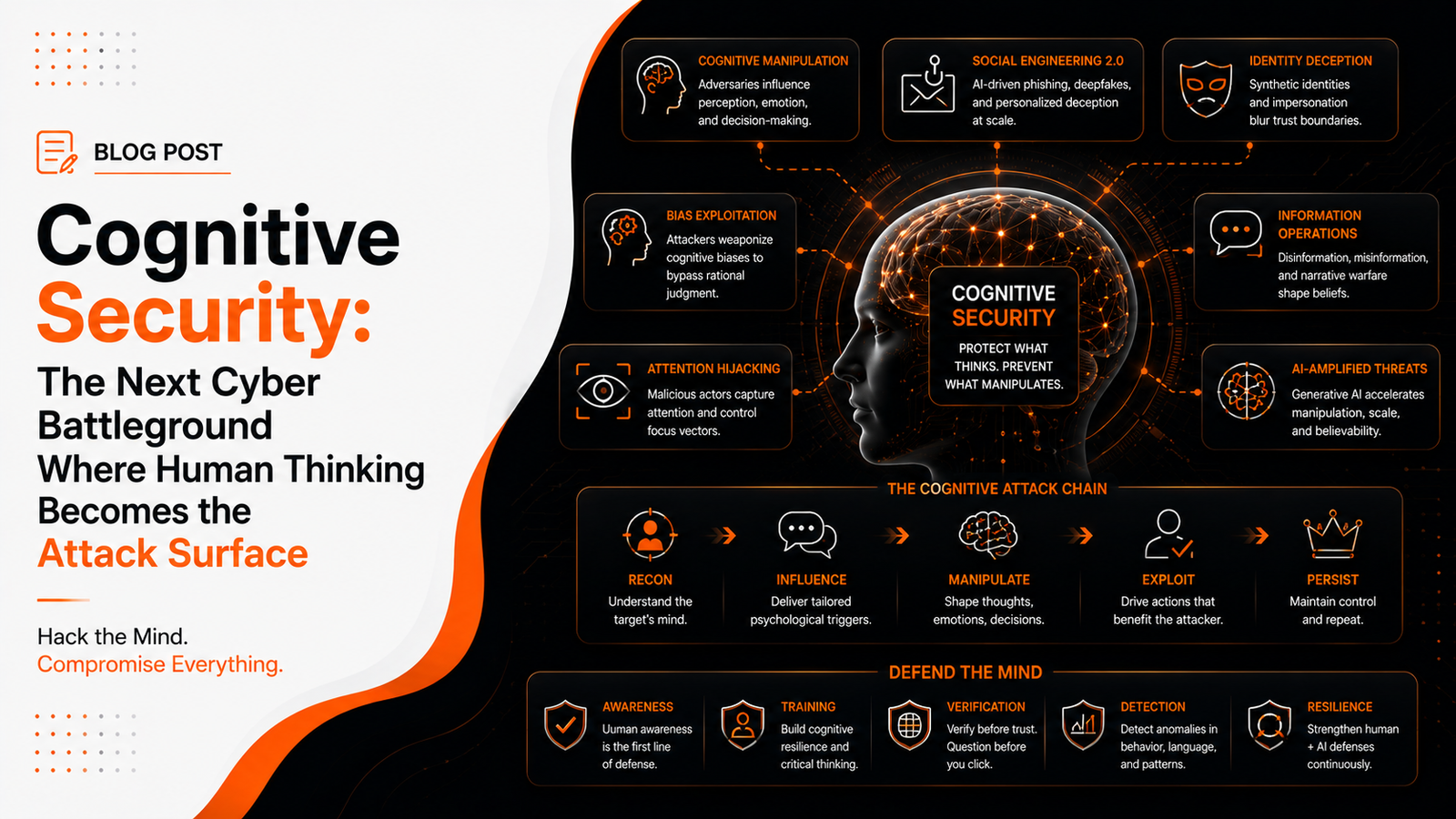
This shift has given rise to an emerging discipline known as Cognitive Security — the practice of protecting human cognition against manipulation, deception, misinformation, and AI-assisted psychological attacks.
Unlike traditional cybersecurity, which primarily defends digital assets, cognitive security recognizes that human thinking itself has become a critical attack surface. As artificial intelligence becomes increasingly capable of generating personalized content at massive scale, defending the human decision-making process is rapidly becoming one of cybersecurity's greatest challenges.
Understanding Cognitive Security
Cognitive Security is the intersection of cybersecurity, psychology, behavioral science, artificial intelligence, and information security. Its primary objective is not merely protecting devices but safeguarding how individuals perceive information, evaluate risks, and make decisions.
Traditional security asks: "Can someone access our systems?"
Cognitive security asks: "Can someone manipulate our people into giving away access?"
That distinction is becoming increasingly important. Modern cybercriminals rarely need to break encryption if they can convince an employee to reveal credentials voluntarily. Likewise, they don't need sophisticated malware if they can persuade an executive to approve a fraudulent payment. The battlefield has shifted from software vulnerabilities to human vulnerabilities.
The Evolution of Cyber Threats
Cybersecurity has evolved through multiple generations.
Generation One: Technical Exploitation
Early attackers primarily targeted technical weaknesses: buffer overflows, weak passwords, unpatched software, and network vulnerabilities. The objective was simple — exploit technology.
Generation Two: Social Engineering
Attackers soon discovered that manipulating people required far less effort than exploiting software. Examples include phishing emails, fake login pages, fraudulent phone calls, USB baiting attacks, and Business Email Compromise (BEC). Instead of hacking machines, attackers began hacking trust.
Generation Three: AI-Powered Manipulation
Today's attacks increasingly leverage artificial intelligence. Large Language Models can produce convincing phishing emails in multiple languages. Voice cloning systems can imitate executives. Image generation tools create realistic fake identities. Video synthesis enables highly convincing deepfakes.
Rather than targeting thousands of victims with generic scams, attackers can now create personalized psychological attacks at unprecedented scale. This evolution marks the beginning of cognitive cybersecurity.
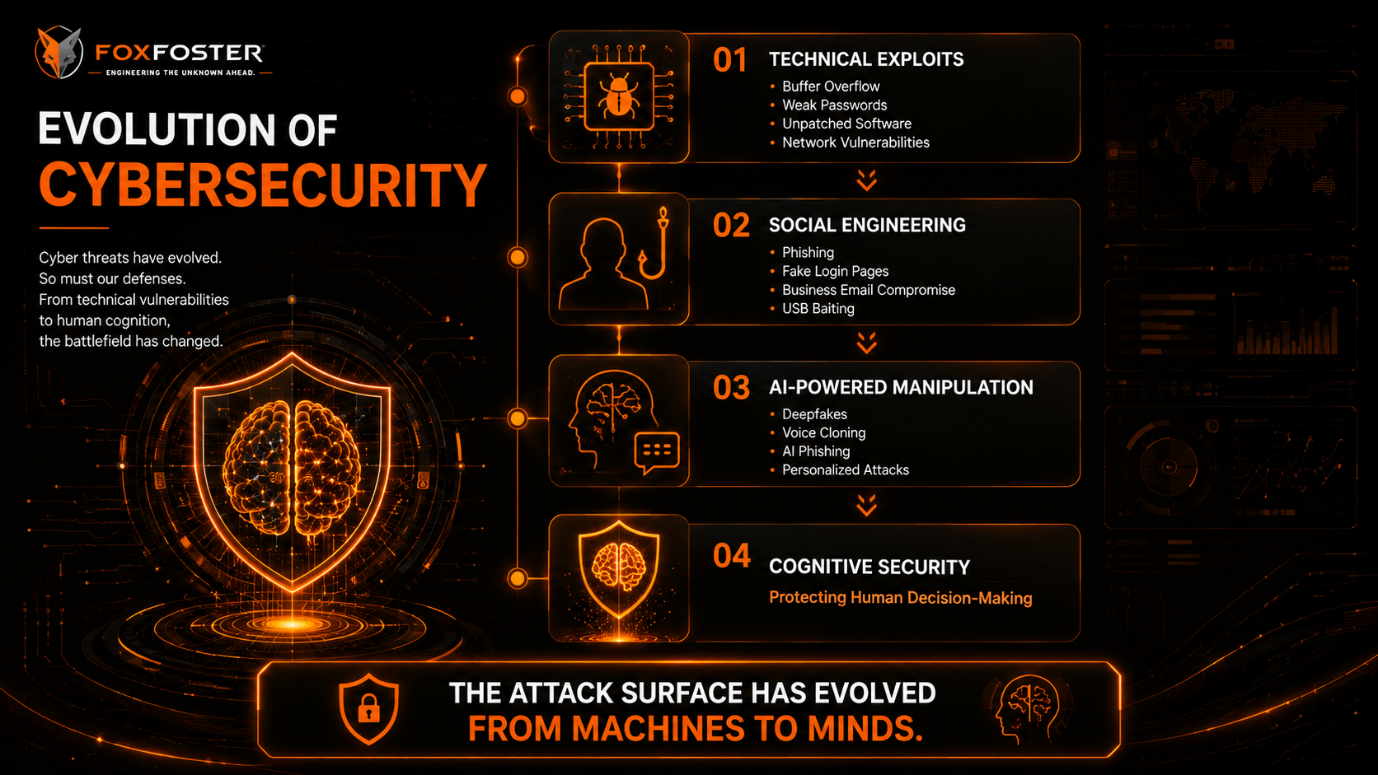
Figure 1: Evolution of Cybersecurity.
Why Human Cognition Is an Attack Surface
Every day people make thousands of decisions based on incomplete information. Attackers understand this remarkably well. Instead of forcing access, they influence decisions.
Human cognition relies on mental shortcuts known as cognitive biases. These shortcuts make daily life easier but also create opportunities for manipulation. Some commonly exploited biases include:
Authority Bias
People naturally trust individuals who appear powerful or knowledgeable. This explains why fake CEO emails often succeed. Employees hesitate to question instructions seemingly issued by senior executives.
Urgency Bias
Urgent requests reduce critical thinking. Messages such as "Your account will expire today," "Immediate payment required," or "Security alert — verify now" encourage victims to act before verifying authenticity.
Familiarity Bias
Individuals trust brands, websites, and interfaces they recognize. Attackers frequently imitate trusted organizations because familiarity lowers suspicion.
Confirmation Bias
People tend to believe information that aligns with existing beliefs. Disinformation campaigns frequently exploit this tendency by reinforcing preconceived opinions.
Scarcity Bias
Limited-time offers trigger emotional decision-making. Examples include limited access invitations, exclusive investment opportunities, and time-sensitive discounts. These tactics encourage immediate action while reducing careful analysis.
Artificial Intelligence Changes the Game
Artificial intelligence has dramatically increased both the scale and sophistication of cognitive attacks. Previously, convincing phishing campaigns required skilled writers and considerable preparation. Today, AI systems can generate thousands of personalized messages within minutes.
Attackers can automatically customize communications using publicly available information, including job titles, professional interests, social media activity, recent company announcements, and public conference presentations. Each victim receives content specifically tailored to maximize credibility. The result is a significant increase in successful social engineering attacks.
Deepfakes: Trust Without Authenticity
One of the fastest-growing cognitive threats involves synthetic media. Deepfake technologies can produce realistic voices, images, videos, and even video conference participants.
Imagine receiving a video call from your organization's Chief Financial Officer requesting an urgent international payment. Everything appears authentic — the face, the voice, the mannerisms, the urgency. Yet none of it is real.
Traditional cybersecurity tools cannot determine whether a human decision is being manipulated by synthetic media. That challenge belongs to cognitive security.
Information Warfare Beyond the Enterprise
Cognitive attacks are not limited to organizations. Entire populations can become targets. Disinformation campaigns often attempt to influence elections, financial markets, public health decisions, political opinions, and social stability.
Rather than stealing data, these operations seek to influence beliefs. A carefully coordinated misinformation campaign can create confusion, distrust, panic, or polarization without ever deploying malware. This demonstrates that information itself has become a strategic weapon.
Increasingly, nation-state actors employ coordinated information campaigns to manipulate public opinion, influence political discourse, and create societal polarization. Unlike conventional cyberattacks that target systems, information warfare seeks to shape perceptions, making cognitive resilience an essential component of national cybersecurity.
The Cognitive Attack Lifecycle
Most cognitive attacks follow a structured progression.
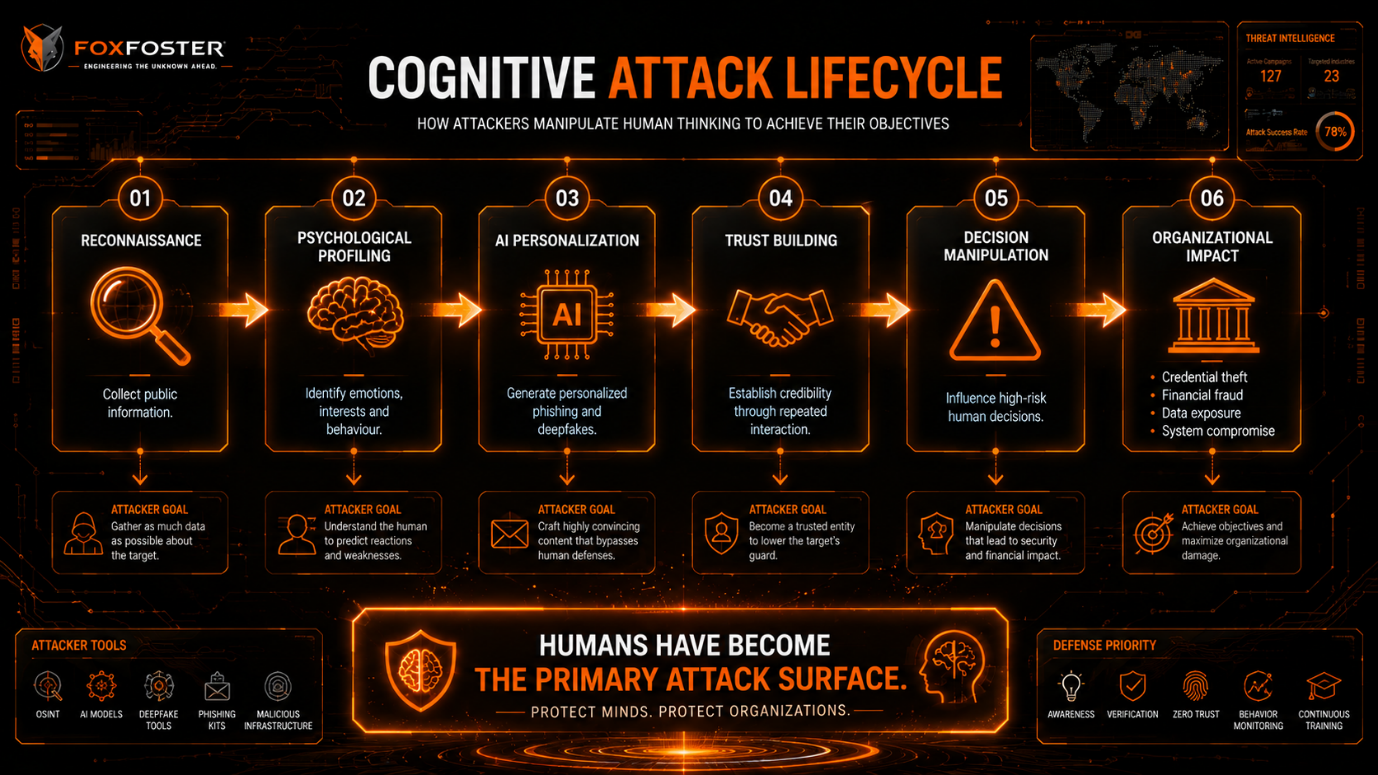
Figure 2: Cognitive Attack Lifecycle.
Phase 1: Intelligence Gathering
Attackers collect publicly available information through social media, company websites, professional networking platforms, public records, and news articles.
Phase 2: Psychological Profiling
Victims are analyzed to determine interests, relationships, communication style, professional responsibilities, and decision-making authority. Attackers rarely target victims randomly. They build psychological profiles using publicly available information such as job roles, online behavior, professional achievements, and social media activity.
Phase 3: AI Personalization
Modern generative AI enables attackers to personalize emails, chat messages, fake documents, and even voice conversations at scale. Instead of sending one generic phishing campaign to thousands of users, adversaries can generate thousands of unique messages, each tailored to an individual's behavior, language, and professional context.
Phase 4: Trust Building
Rather than requesting sensitive information immediately, sophisticated attackers gradually establish credibility through multiple interactions. This may involve impersonating trusted colleagues, referencing previous conversations, or maintaining long-term communication until the victim lowers their guard.
Phase 5: Decision Manipulation
Victims are encouraged to open malicious files, reveal credentials, transfer funds, approve transactions, install software, or share confidential information. The compromise occurs because the victim believes they are making the correct decision.
Cognitive Security Inside Organizations
Organizations increasingly recognize that employee awareness training alone is insufficient. Watching annual security videos does not prepare employees for highly personalized AI-generated deception. A mature cognitive security program typically combines multiple defensive layers:
- Continuous Awareness: Training should be ongoing rather than annual. Employees need exposure to evolving attack techniques instead of static compliance presentations.
- Behavioral Monitoring: Rather than focusing exclusively on network activity, organizations should also monitor unusual behavioral patterns such as unexpected financial approvals, abnormal communication requests, unusual authentication behavior, and high-risk workflow deviations.
- AI-Assisted Verification: Artificial intelligence can help detect inconsistencies within communications by analyzing writing style, context, metadata, conversation history, and identity confidence. These systems provide an additional verification layer before critical actions occur.
- Identity Verification: Organizations should adopt strong identity verification practices before approving sensitive requests. Video calls, financial transactions, privileged access requests, and password reset approvals should all include independent verification mechanisms rather than relying solely on email or messaging platforms.
- Multi-Person Approval: High-risk decisions should require independent verification. Financial transfers, privileged access requests, and sensitive data sharing should involve multiple authorized individuals. This reduces the effectiveness of cognitive manipulation against a single employee.
- Human-Centered Security Design: Many security systems assume users behave rationally under pressure. Reality is very different. Stress, fatigue, workload, and urgency significantly affect decision quality. Human-centered security focuses on designing systems that reduce cognitive burden — clear authentication prompts, simple security warnings, context-aware risk notifications, reduced alert fatigue, and intelligent approval workflows.
The Role of Cognitive Security in AI Agents
AI assistants are becoming integrated into email platforms, browsers, productivity suites, and enterprise workflows. These systems increasingly make recommendations or even perform actions on behalf of users. This creates a new category of risk.
If attackers manipulate the AI assistant rather than the user directly, they may indirectly influence organizational decisions. Protecting AI reasoning processes therefore becomes part of cognitive security.
Future enterprise AI systems will likely require context verification, instruction validation, source authenticity checks, multi-layer reasoning safeguards, and human approval for sensitive operations. Without these protections, AI agents themselves may become targets of psychological manipulation.
Building a Cognitive Security Framework
Organizations preparing for next-generation threats should consider a framework built around five pillars. Together, these components create resilience against both technological and psychological attacks.
| Pillar | Objective |
|---|---|
| Awareness | Improve human recognition of manipulation techniques |
| Verification | Validate identity and information before acting |
| AI Governance | Monitor and secure AI-assisted workflows |
| Behavioral Analytics | Detect unusual decision patterns |
| Continuous Learning | Adapt defenses as attacker techniques evolve |
Zero Trust for Human Decisions: Traditional Zero Trust focuses on verifying users, devices, and applications before granting access. Cognitive Security extends this philosophy to human decision-making by encouraging organizations to verify critical requests regardless of who appears to make them. Whether an email comes from a CEO, a trusted vendor, or an AI assistant, important decisions should always be independently validated before action is taken.
Challenges Ahead
Cognitive security remains an emerging discipline. Several challenges remain unresolved.
- Distinguishing legitimate persuasion from malicious manipulation is inherently difficult.
- AI-generated content continues improving faster than many detection technologies.
- Organizations often underestimate psychological risk because traditional cybersecurity metrics focus on technical vulnerabilities.
- Balancing security with usability remains a persistent challenge. Excessive verification processes may reduce productivity, while insufficient verification increases organizational exposure.
Finding the right balance will require collaboration between cybersecurity professionals, behavioral scientists, AI researchers, and policy makers.
Looking Toward the Future
Over the next decade, cybersecurity is likely to become increasingly human-centric. Future security operations centers may monitor not only malware and network traffic but also misinformation campaigns, synthetic media, AI-assisted fraud, and behavioral manipulation.
Organizations will likely develop specialized Cognitive Security Teams responsible for protecting both digital infrastructure and human decision-making. Universities are already expanding interdisciplinary research combining cybersecurity, neuroscience, psychology, and artificial intelligence. As digital systems become more autonomous, protecting cognition may become as important as protecting data.
Key Takeaways
- Modern attackers increasingly target human decision-making rather than software vulnerabilities.
- Artificial intelligence enables highly personalized cognitive attacks at unprecedented scale.
- Deepfakes, misinformation, and AI-generated deception represent growing organizational risks.
- Cognitive security combines cybersecurity, psychology, behavioral science, and AI governance.
- Organizations should treat human cognition as a critical security asset deserving dedicated protection.
- Future cybersecurity strategies must defend both machines and minds.
Conclusion
Cybersecurity is no longer solely about defending servers, applications, or networks. The next generation of threats increasingly focuses on influencing how people think, trust, and decide. Every convincing phishing email, synthetic voice call, deepfake video, and AI-crafted message demonstrates that manipulating human cognition can be more effective than exploiting software flaws.
Cognitive Security represents a necessary evolution in defensive thinking. It expands the security perimeter beyond digital infrastructure to include the human mind — the ultimate decision-maker behind every system. As artificial intelligence continues to blur the boundaries between authentic and fabricated information, organizations must prepare for a future where resilience depends not only on stronger technology but also on stronger judgment.
The organizations that succeed in the coming years will not simply build better firewalls; they will cultivate informed, skeptical, and resilient decision-makers capable of recognizing manipulation before it becomes compromise. In an era where information itself can be weaponized, protecting cognition may prove to be the most valuable security investment of all.
MITRE ATLAS · NIST AI Risk Management Framework · OWASP Top 10 for LLM Applications · ENISA Threat Landscape · OpenAI Research · Microsoft Security · Google DeepMind Safety Research