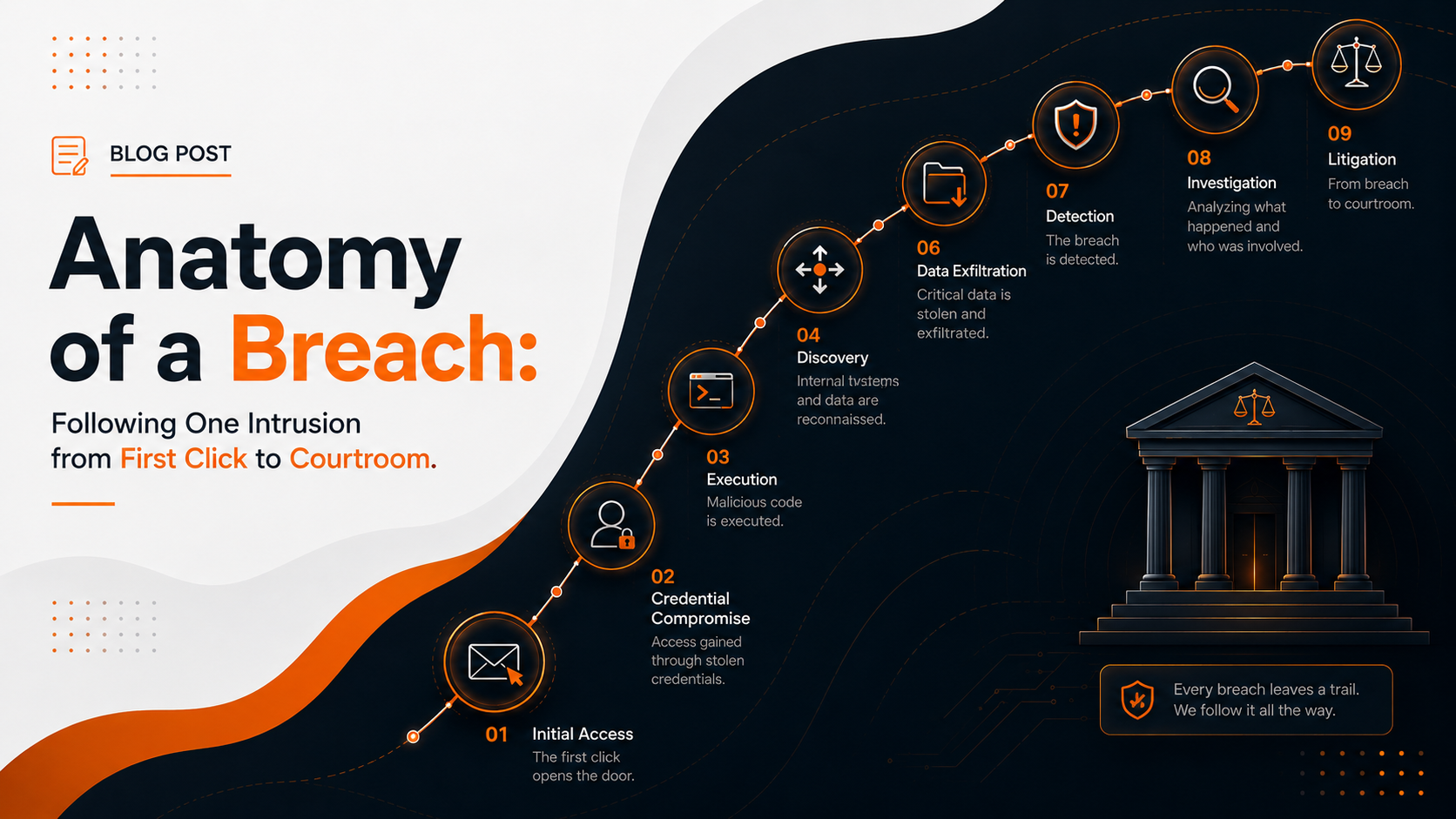
A Cybersecurity Case Study & Executive Briefing — Threat Lifecycle · Detection · Incident Response · Forensics · Recovery · Law
Executive Summary
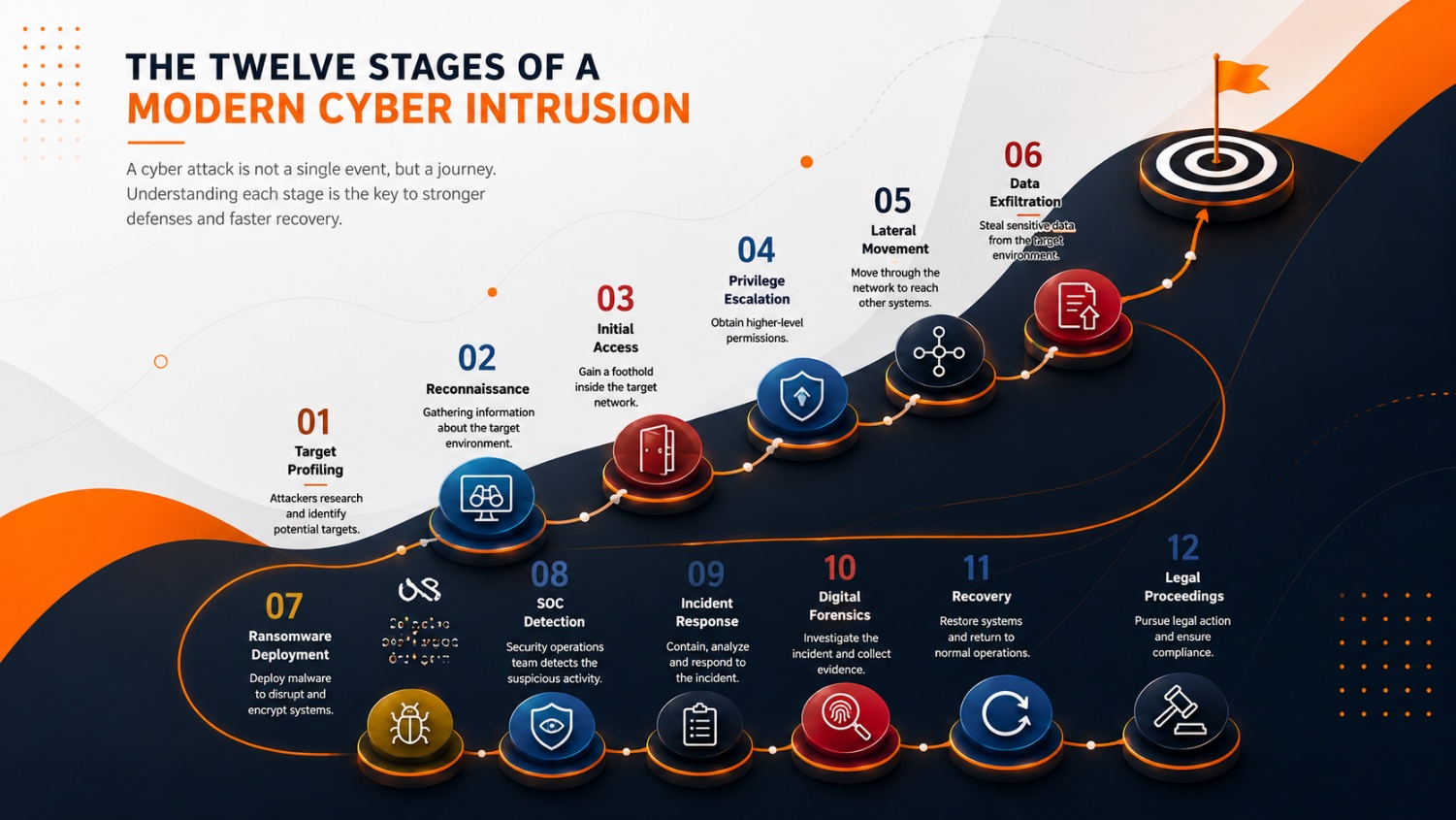
Every large-scale cyber intrusion tells the same underlying story, even when the technical details differ. An adversary studies a target, finds a way inside, expands their reach, extracts something of value, and eventually forces a confrontation — whether through extortion, sabotage, or theft. This report walks through that arc from beginning to end, using a single composite case to illustrate how each stage connects to the next.
The organization at the center of this report, Northgate Industrial Group, is fictional, and its employee, Maya Chen, is a composite drawn from patterns observed across many real investigations. The techniques, however, are drawn directly from how contemporary intrusions actually unfold: patient reconnaissance, credential abuse, quiet lateral movement, data theft ahead of encryption, and a recovery process that reshapes an organization's entire approach to risk.
The purpose of this report is not to dramatize cybercrime. It is to show how twelve different disciplines — from recon to courtroom — come together into one event.
Chapter 1 — Cybercrime as an Industry
The attacker seldom acts with malice toward any particular individual. They do it simply because the numbers are on their side.
One gets tempted to view the cybercriminal as an isolated individual who works in a darkened room. The modern reality looks far more like a supply chain. Initial-access brokers sell footholds into corporate networks. Malware developers lease their tools to affiliates on a revenue-share basis. Negotiators handle victim communication. Money launderers make the currency ready for use. Even the cybercrime underground marketplace has customer support, escrow services, and regular updates.
This is important because the skill threshold needed to carry out an attack has been lowered. The hacker no longer needs to write custom malware, locate a zero-day vulnerability, or even understand cryptography — all the attacker needs is money to pay others who have done this. Before anything technical happens, the attacker determines whether the potential target is worth the effort. The criteria resemble a due-diligence checklist:
- Can the business tolerate downtime, or does every hour offline bleed revenue?
- Is there evidence of cyber insurance, which often signals a willingness to pay?
- How mature does the security program appear from the outside?
- Does the organization hold data that is valuable on its own, independent of any ransom?
- How quickly, based on public information, might leadership authorize a payment?
Northgate Industrial Group, a mid-sized manufacturer with several thousand employees and a handful of overseas plants, checked several of these boxes. Downtime on its production lines was expensive. Its cyber insurance policy was mentioned in a press release about a prior audit. Its security team, while competent, was small relative to its footprint. None of this made Northgate careless — it simply made it economically attractive.
Key idea: an attacker's first decision is rarely technical. It is financial. Understanding that reframes almost every later stage of the intrusion.
Chapter 2 — Reconnaissance: Building a Profile Without Touching the Network
Long before Northgate's security tools recorded a single suspicious event, an unseen analyst was assembling a profile of the company and its people. None of the sources involved were secret. LinkedIn revealed org charts and job titles. The corporate site listed executives and named suppliers. A handful of forgotten PDFs, indexed by search engines years earlier, still described internal project names. DNS records mapped out which services faced the internet.
One name kept surfacing: Maya Chen, an accounts-payable specialist who regularly posted about her role coordinating supplier invoices — useful, mundane information that made her an ideal entry point.
Why This Stage Is Invisible to Defenders
None of the reconnaissance actions were illegal or even unusual in isolation. Reading a public LinkedIn profile is not an intrusion. Reviewing a company's own website is not a crime. From a defender's vantage point, nothing had happened yet — no alert fired, because no boundary had been crossed. Yet by the time reconnaissance concluded, the attacker already knew more about Northgate's supplier relationships than most of its own new hires.
This is the paradox at the heart of the earliest phase of an intrusion: it is completely legal, entirely public, and quietly decisive.
Chapter 3 — Initial Access: The Cost of a Single Click
On a Monday morning, Maya opened an email that appeared to come from a supplier she corresponded with weekly. The subject referenced an updated purchase order. The formatting matched prior threads. The attached PDF opened normally, displaying a document that looked entirely legitimate.
Behind that unremarkable moment, a chain of technical events unfolded in seconds. The PDF reader, exploiting a scripting flaw, spawned a hidden PowerShell process. That process reached out to an external server over an encrypted connection and pulled down a small, memory-resident payload — nothing was written to disk that traditional antivirus would immediately flag.
Why Phishing Still Works
Security awareness training often frames phishing as a failure of attention. In practice, well-crafted phishing succeeds because it exploits routine, not carelessness. Maya processed dozens of similar emails every week; this one was indistinguishable from the rest because the attacker had built it using the exact reconnaissance gathered earlier — the right supplier name, the right tone, the right timing in the invoice cycle.
What a Detection Engineer Would Look For
Modern endpoint detection platforms flag this kind of behavior not by recognizing the malware itself, but by recognizing an unusual relationship between processes — a document viewer that should never spawn a scripting engine:
// Detection logic: office/PDF reader spawning a scripting host
event.category == "process_creation"
  AND parent_process.name IN ("AcroRd32.exe","WINWORD.EXE","EXCEL.EXE")
  AND child_process.name IN ("powershell.exe","wscript.exe","mshta.exe")
  AND child_process.command_line CONTAINS ("-enc","-w hidden","IEX")
=> severity: HIGH, alert: "Suspicious document-to-script execution"
This single rule — watching for a document viewer that behaves like an administrator's console — would have caught this intrusion in its first sixty seconds. It did not fire that day, because the rule had not yet been deployed at Northgate.
Chapter 4 — Privilege Escalation: From User to Domain Control
A single user account from an accounts-payable machine is a small accomplishment. Maya's account could approve invoices, not create domain administrators, disable security tooling, or reach the backup infrastructure. To matter, the intrusion needed more authority.
The operator spent the next two hours quietly enumerating the environment: which security product was installed, whether the machine was domain-joined, who else had recently logged in. That last question produced the opening they needed — an IT technician had remotely serviced Maya's machine earlier that morning, and remnants of that authenticated session lingered in memory.
Two Escalation Patterns
Security teams generally describe privilege escalation along two axes. Vertical escalation increases the level of authority — moving from standard user to local administrator to domain administrator. Horizontal escalation swaps identity, borrowing someone else's already-elevated access. In this case, both occurred: the technician's cached credentials offered horizontal movement into an account with broader reach, which was then used to escalate vertically.
| Tactic | Technique | Observed Behavior |
|---|---|---|
| Credential Access | OS Credential Dumping (T1003) | In-memory extraction of cached authentication material |
| Privilege Escalation | Valid Accounts (T1078) | Reuse of a technician's elevated session |
| Defense Evasion | Impair Defenses (T1562) | Attempted tampering with endpoint protection settings |
| Discovery | System Owner/User Discovery (T1033) | Enumeration of logged-on and recently active accounts |
Practical takeaway: routine IT support sessions on end-user devices are a frequently overlooked escalation path. Privileged access workstations and just-in-time elevation exist specifically to close this gap.
Chapter 5 — Lateral Movement: One Laptop Becomes an Enterprise
With elevated credentials in hand, the intrusion changed shape. It no longer needed Maya's laptop at all. Over the following days, the operator moved methodically between systems using tools any IT administrator would recognize — remote PowerShell sessions, SMB file shares, scheduled tasks pushed through existing management infrastructure.
None of this required new malware. This strategy, known as living off the land, is simple: the more the intrusion looks like normal administration, the longer it survives.
Mapping the Terrain
The operator used directory queries to construct an organizational map more detailed than any org chart — Domain Admins, service accounts with little password rotation, backup infrastructure locations, and file shares containing the company's most sensitive data.
Two groups of systems received special attention. Service accounts — the non-human credentials that keep applications and backups running — are frequently over-privileged and under-monitored. Backup servers became a priority because neutralizing them in advance would remove Northgate's ability to restore its way out of what was coming.
Chapter 6 — Data Exfiltration: Building Leverage Before Encryption
Contemporary ransomware operations rarely rely on encryption alone. Before triggering any destructive payload, the operator spent several quiet, off-hours sessions locating and copying the material most likely to hurt Northgate if published — supplier contracts, payroll records, engineering drawings, legal correspondence, and authentication secrets found in configuration files.
Roughly 180 gigabytes left the network over two nights, most of it during a period when the SOC was operating with a reduced overnight staff.
Double Extortion, Explained
The strategic logic is straightforward. Encryption alone gives a victim one path to recovery: restore from backup. Data theft closes that path by adding a second, independent form of pressure — the threat of public disclosure — that backups cannot undo. Once both levers exist, the victim faces not one crisis but two simultaneous ones: an operational outage and a potential confidentiality breach.
Detection opportunity: sustained, off-hours outbound transfers to cloud storage — particularly from accounts that don't normally handle bulk file movement — remain one of the more reliable signals available to a monitoring team, provided someone is watching for it.
Chapter 7 — Detonation: The Afternoon the Business Stopped
On Friday at 5:30 PM, with much of the workforce already departed for the weekend, the operator issued a single administrative command. What had taken weeks to prepare took minutes to execute.
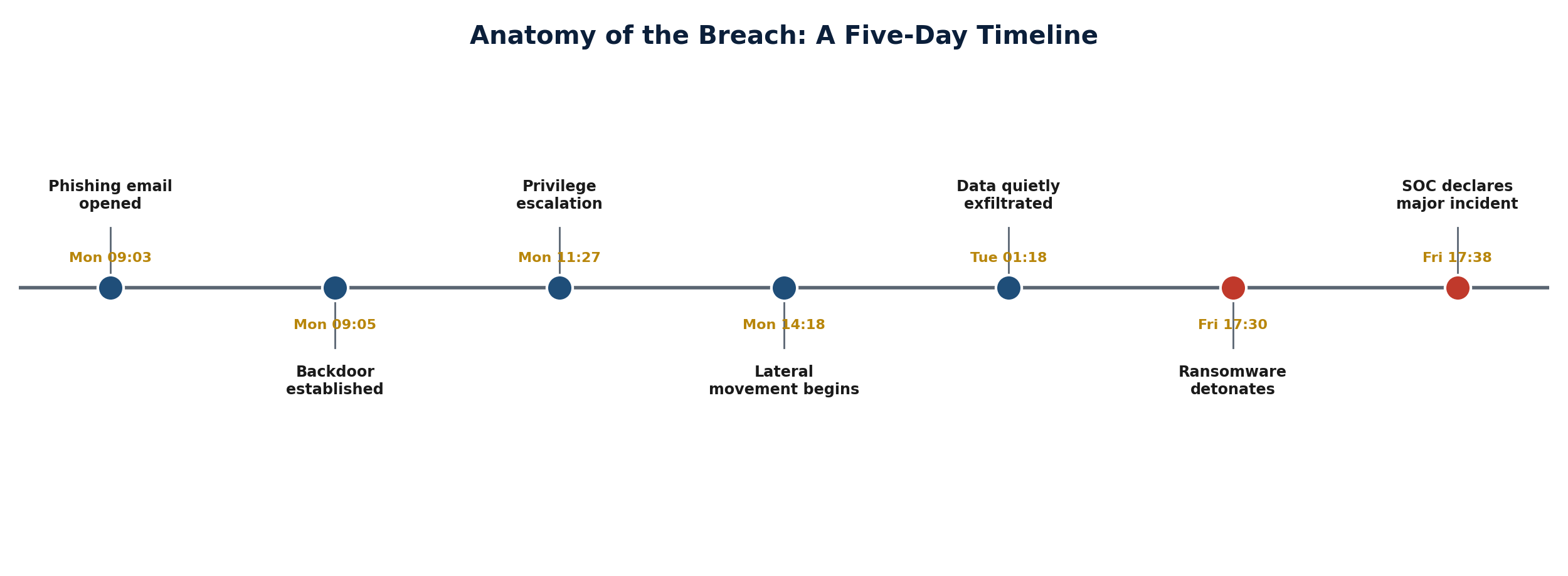
Within three minutes, systems across finance, engineering, and manufacturing began reporting inaccessible files. By minute five, the primary file server was unreadable. By minute seven, production-floor terminals lost access to specifications, and plant managers began halting equipment by hand.
Why the Ransom Decision Has No Clean Answer
Executives facing this moment are rarely choosing between a good option and a bad one; they are choosing between several imperfect ones, weighing operational cost, backup reliability, legal exposure, the ethics of funding criminal enterprises, and the simple uncertainty of whether payment would even produce a working decryption key. Organizations that have thought through this decision in advance consistently make better ones.
Chapter 8 — Inside the SOC: Reconstructing What Already Happened
By the time encryption began, Northgate's SOC had already logged a handful of low-priority anomalies — an unusual PowerShell parent process, an odd authentication pattern. None had been escalated. The ransomware note changed that instantly.
The team's first priority was not remediation but reconstruction: identifying the earliest point of compromise, because acting before understanding the full scope risks removing the visible malware while leaving the attacker's actual access intact.
Reading the Evidence
Analysts worked backward through centralized logs, endpoint telemetry, and DNS records. A single Windows process-creation event — a PDF reader spawning PowerShell at 9:04 on Monday morning — became the anchor point around which the entire timeline was rebuilt.
// SIEM query used to reconstruct the initial-access timeline
index=endpoint sourcetype=process_creation
| search parent_process="AcroRd32.exe" child_process="powershell.exe"
| eval stage="Initial Access"
| append [ search index=dns query_domain!=*.northgate.internal
           | where isnew_domain=1 | eval stage="C2 Communication" ]
| append [ search index=auth EventCode=4672
           | eval stage="Privileged Logon" ]
| table _time, host, user, stage, detail
| sort _time
Containment Actions Taken
- Disabled the compromised accounts, including the technician credential that enabled escalation
- Rotated all privileged and service-account passwords enterprise-wide
- Blocked the identified command-and-control domains and IP ranges at the perimeter
- Isolated affected network segments to halt further lateral spread
- Preserved volatile memory on still-running systems before any shutdown
Chapter 9 — Incident Response: The First 72 Hours
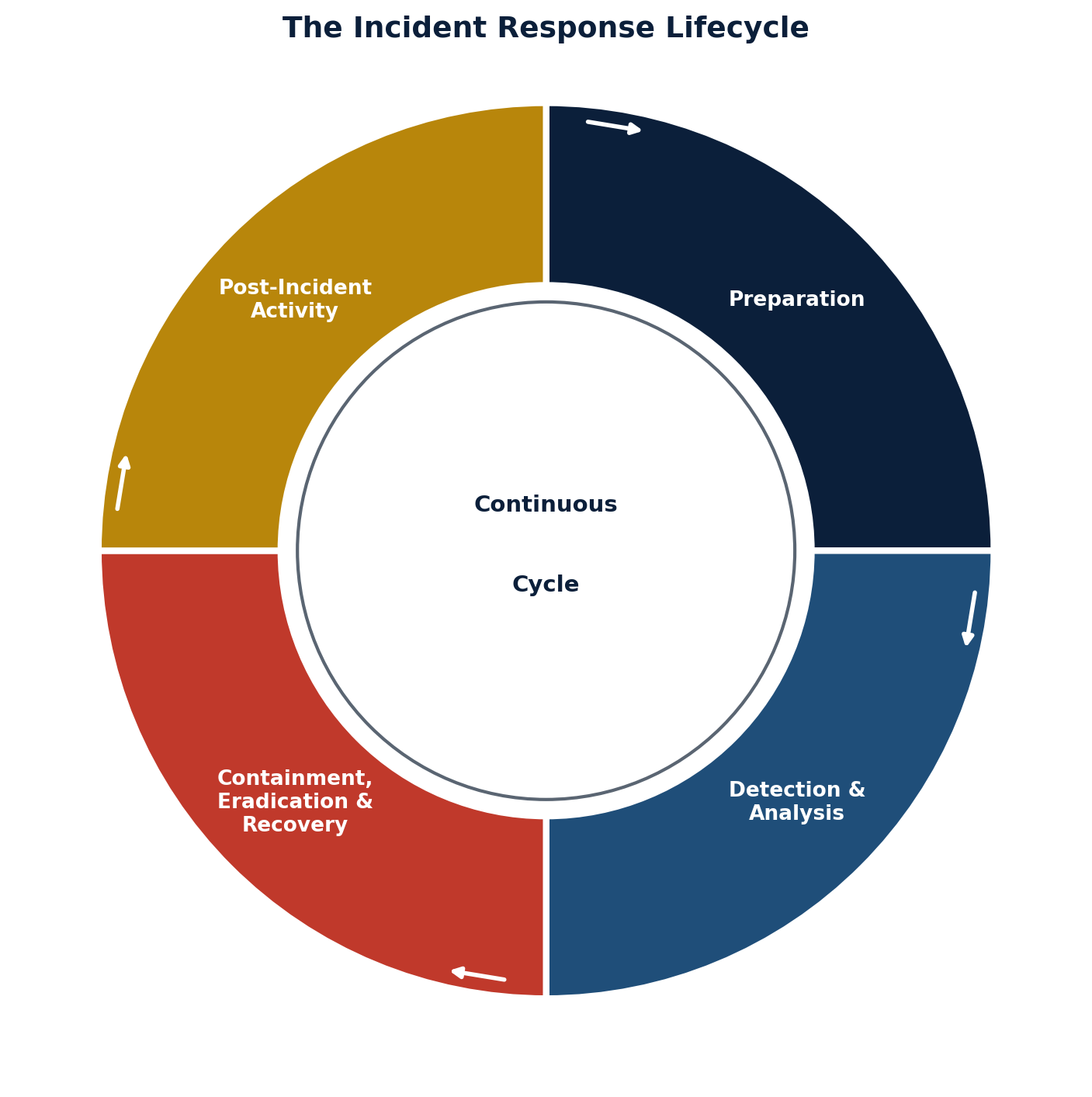
The technical investigation and crisis management efforts began simultaneously. Within ninety minutes, an interdisciplinary response team comprising security engineers, lawyers, HR, communications experts, and executives had been formed.
Decisions That Could Not Wait
One server showing signs of active attacker presence was deliberately left powered on just long enough to capture memory. The backup team discovered that several backup jobs had been silently failing for weeks. Legal counsel flagged jurisdiction-specific notification obligations well before the scope of stolen data was fully known.
The company's cyber insurance carrier was notified within hours, triggering a panel of external forensic and legal specialists who joined the internal team.
Principle: contain before you recover. Restoring systems while an attacker retains access simply resets the clock on the same intrusion.
Chapter 10 — Digital Forensics: Turning Artifacts Into a Narrative
Forensic investigation is slower and more meticulous than incident response, serving a different purpose: not to stop the bleeding, but to produce a defensible account of exactly what happened, suitable for regulators, insurers, and a courtroom.
Investigators worked from forensic images of Maya's laptop and several servers, correlating registry modifications, scheduled-task creation, Windows Event Log entries, browser artifacts, and memory captures into a single timeline. Every image, every log export, and every transfer of evidence was logged in a formal chain of custody.
| Artifact | What It Typically Shows |
|---|---|
| Windows Event Logs | Process creation, logon events, privilege use |
| Prefetch files | Evidence of program execution, even after deletion |
| Registry hives (Run keys, services) | Persistence mechanisms installed by the attacker |
| Memory capture | Running processes, network connections, in-memory credentials |
| Network flow logs | Volume, timing, and destination of data transfers |
No single artifact told the whole story. The strength of the final report came from dozens of small, individually unremarkable pieces of evidence lining up into one coherent sequence.
Chapter 11 — Recovery: Rebuilding Systems and Trust
Restoring a server is a matter of hours. Restoring confidence — among employees, customers, regulators, and the board — takes considerably longer.
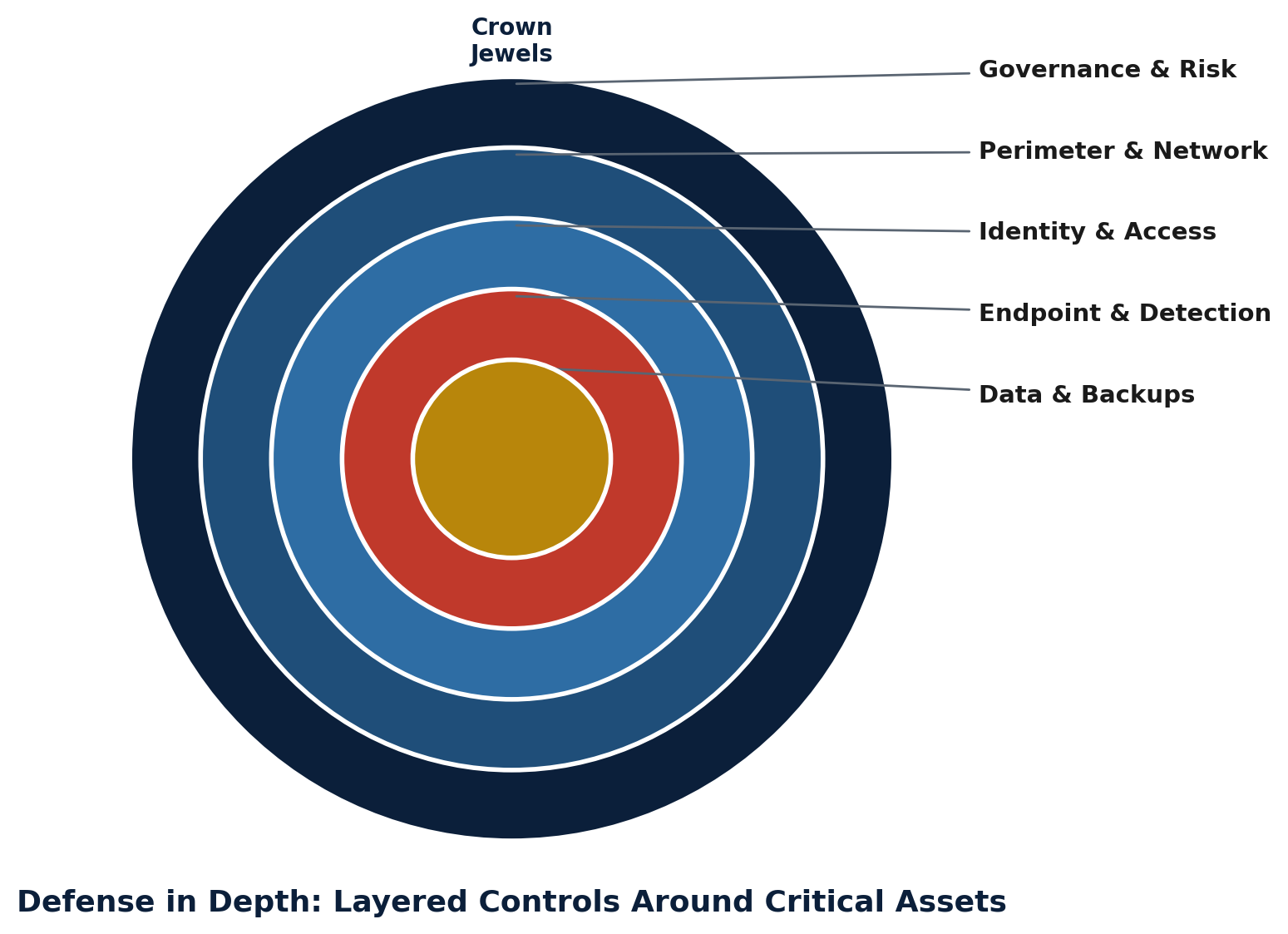
What Actually Changed
- Every backup job was tested through a full restoration exercise, not merely confirmed to exist
- Multi-factor authentication became mandatory for all privileged and remote access
- The flat internal network was re-segmented into isolated zones by function
- A phased move toward a zero-trust architecture began
- Security awareness training moved from an annual event to recurring monthly practice
- Board-level reporting on cyber risk became a standing agenda item
None of these controls were exotic. What changed was not the available technology, but the organization's willingness to prioritize it.
Chapter 12 — The Legal Aftermath: When Evidence Meets the Court
Nine months after the ransom note appeared, Northgate's production lines had returned to normal. For investigators and prosecutors, however, the case was only reaching its most demanding phase — proving, to a legal standard, what the technical evidence already showed.
Northgate's lead forensic analyst was called to testify as an expert witness. Her task was to explain to a courtroom with no technical background why the digital evidence supported specific conclusions — and what it did not prove.
Fact Versus Inference
A log entry can show that a command executed from a given IP address at a given time. It cannot, by itself, prove who was sitting at that keyboard. Attribution typically requires a broader body of evidence — infrastructure reuse, financial trails, operational patterns — assembled across multiple investigations and often multiple countries.
Tracing the ransom payment illustrated this well. The underlying blockchain was fully transparent; investigators followed the funds across a chain of wallets until a portion reached a regulated exchange, which was compelled to disclose account information. The blockchain did not name a suspect. It produced a trail that, combined with other evidence, eventually did.
Why Prosecution Is Rarely Tidy
Cross-border cybercrime cases routinely involve infrastructure in one country, operators in another, and financial instruments in a third. Justice in these cases is frequently partial and incremental rather than absolute.
Epilogue — What This Case Actually Teaches
It is easy to read an account like this and focus on the technology — the malware, the encryption, the blockchain trace. The more durable lesson sits elsewhere. Every stage of this intrusion depended on an ordinary human decision: an attacker deciding the expected payoff justified the effort, an employee trusting a familiar-looking email, an administrator postponing a patch, a backup job failing without anyone noticing.
Technology recorded these decisions. It did not make most of them. That is why resilience is built less through any single tool and more through the accumulation of habits — tested backups, segmented networks, continuously verified identity, and a culture where reporting a mistake is safer than hiding it.
The best defenders are not the ones who prevent every attack. They are the ones who make sure that a single mistake never becomes a single point of failure.
Key Takeaways at a Glance
| Stage | Practical Lesson |
|---|---|
| Reconnaissance | Public information is attack surface; audit what your organization exposes |
| Initial Access | Assume phishing will occasionally succeed; design for what happens next |
| Privilege Escalation | Treat routine support sessions as a monitored, privileged event |
| Lateral Movement | Segment networks so one compromised account cannot reach everything |
| Data Exfiltration | Monitor outbound data volume, not just inbound threats |
| Ransomware Deployment | Decide your ransom-payment policy before a crisis, not during one |
| SOC Detection | Correlate small anomalies; the individual signal is rarely enough alone |
| Incident Response | Contain fully before restoring anything back into production |
| Digital Forensics | Preserve chain of custody from the very first action taken |
| Recovery | Test backups by restoring them, not by confirming they exist |
| Legal Proceedings | Expect attribution and prosecution to be partial, slow, and cross-jurisdictional |