The Problem With Vulnerability Scanning
Vulnerability scanners have a dirty secret: they produce more output than you can act on. A single scan can return dozens of findings across a handful of hosts, each tagged with a severity, a template ID, and a URL. In practice, most of that output sits in a PDF nobody reads until the next compliance audit.
The problem was never detection. It's the pipeline after detection — separating a real, exploitable issue from a false positive, ranking what to fix first, and handing the team something they can actually act on.
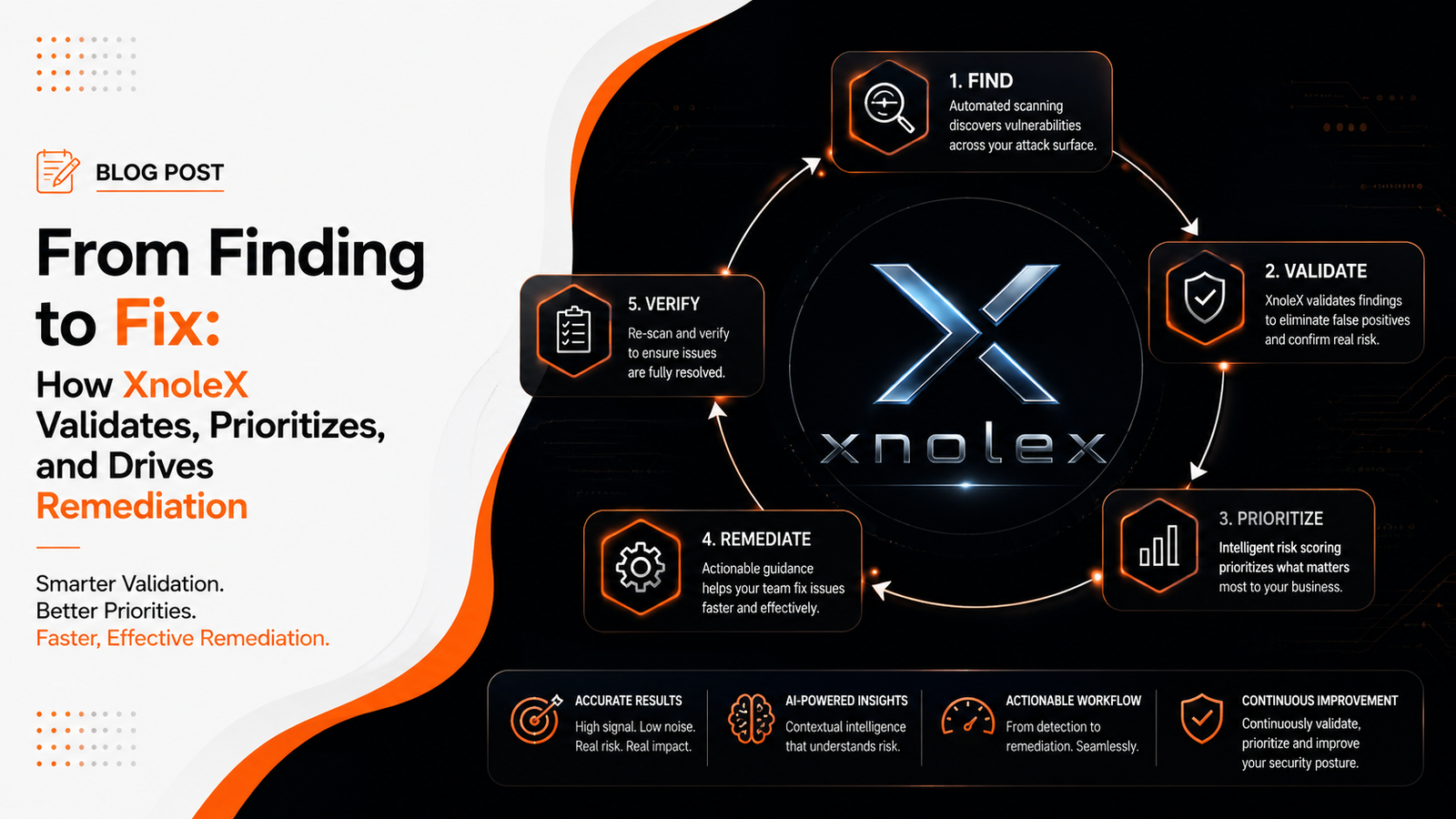
XnoleX was built around that problem. The whole platform runs on a five-stage intelligence workflow designed to turn raw tool output into prioritized, actionable risk.
The Five Stages
Every scan progresses through five stages, and each one produces structured data that feeds the next:
01 · DISCOVER
Attack surface mapping. subfinder enumerates subdomains via passive DNS sources, nmap performs host discovery, and dig resolves each discovered subdomain to an IP. The output is a complete inventory of the target's hosts.
02 · CORRELATE
Subdomains become live services. httpx probes every discovered subdomain plus the root domain for HTTP services, collecting status codes, page titles, and technology fingerprints. The map from stage one becomes a list of concrete, testable endpoints.
03 · VALIDATE
nuclei runs vulnerability templates against every discovered endpoint. Templates cover CVEs, misconfigurations, and exposures across all severity levels — critical, high, medium, low, and info. The result is a list of validated findings, not guesses.
04 · PRIORITIZE
Findings are classified by severity and deduplicated. Every result is keyed on its template ID plus the matched URL, so re-testing the same issue at the same endpoint never produces duplicates. What's left is a clean, ranked list of genuine problems.
05 · ACT
Reports are generated with severity breakdowns, remediation guidance, host-vulnerability mapping, and attack-surface analysis — including critical paths, auth endpoints, admin endpoints, and API endpoints. The output is built to be handed to whoever fixes things.
Validation Without Exploitation
A common question about automated VAPT platforms is where the line sits between assessment and attack. XnoleX is explicit about it: automated vulnerability detection only.
Findings are based on nuclei template matching, which identifies known vulnerability signatures and misconfigurations. The platform does not attempt exploitation, privilege escalation, or any form of active penetration testing. That's a deliberate boundary — it gives you continuous, safe, repeatable assessment without the operational risk of an active attacker running inside your environment.
How Prioritization Actually Works
Severity alone is a starting point, not an answer. Every finding carries five fields that turn it into an actionable work item:
- name — the human-readable vulnerability, e.g. "Apache Struts Remote Code Execution"
- severity — critical, high, medium, low, or info
- template_id — the nuclei template identifier, e.g.
cve-2023-50164 - host and matched_at — exactly which service and URL is affected
- description and remediation — what the problem is and how to fix it
Results are pre-sorted by severity (critical first, info last), and the host-vulnerability map groups findings by affected host. That grouping is where prioritization becomes strategic: one host with five critical findings is a different emergency than five hosts with one critical finding each.
The Output People Actually Use
After the scan completes, the report answers the three questions every security team gets asked:
- How bad is it? — a severity breakdown across the whole target.
- Where exactly? — host-vulnerability mapping pinpoints the affected services.
- What do we do about it? — per-finding remediation guidance, plus attack-surface analysis highlighting the endpoints that matter most: admin panels, authentication surfaces, and APIs.
That last question is the one most tools drop. A finding without remediation guidance is a research project. A finding with remediation guidance is a ticket.
The Takeaway
Detection was never the hard part of vulnerability management. The hard part is the pipeline after it: validating that a finding is real, ranking it against everything else, and delivering it in a form a team can execute on.
The Discover → Correlate → Validate → Prioritize → Act workflow exists precisely to close that loop. Run a full scan for a baseline, use the subdomain engine for attack-surface mapping, and the nuclei engine for fast re-checks on known targets — and every run ends in the same place: a prioritized list of fixes, not a pile of alerts.