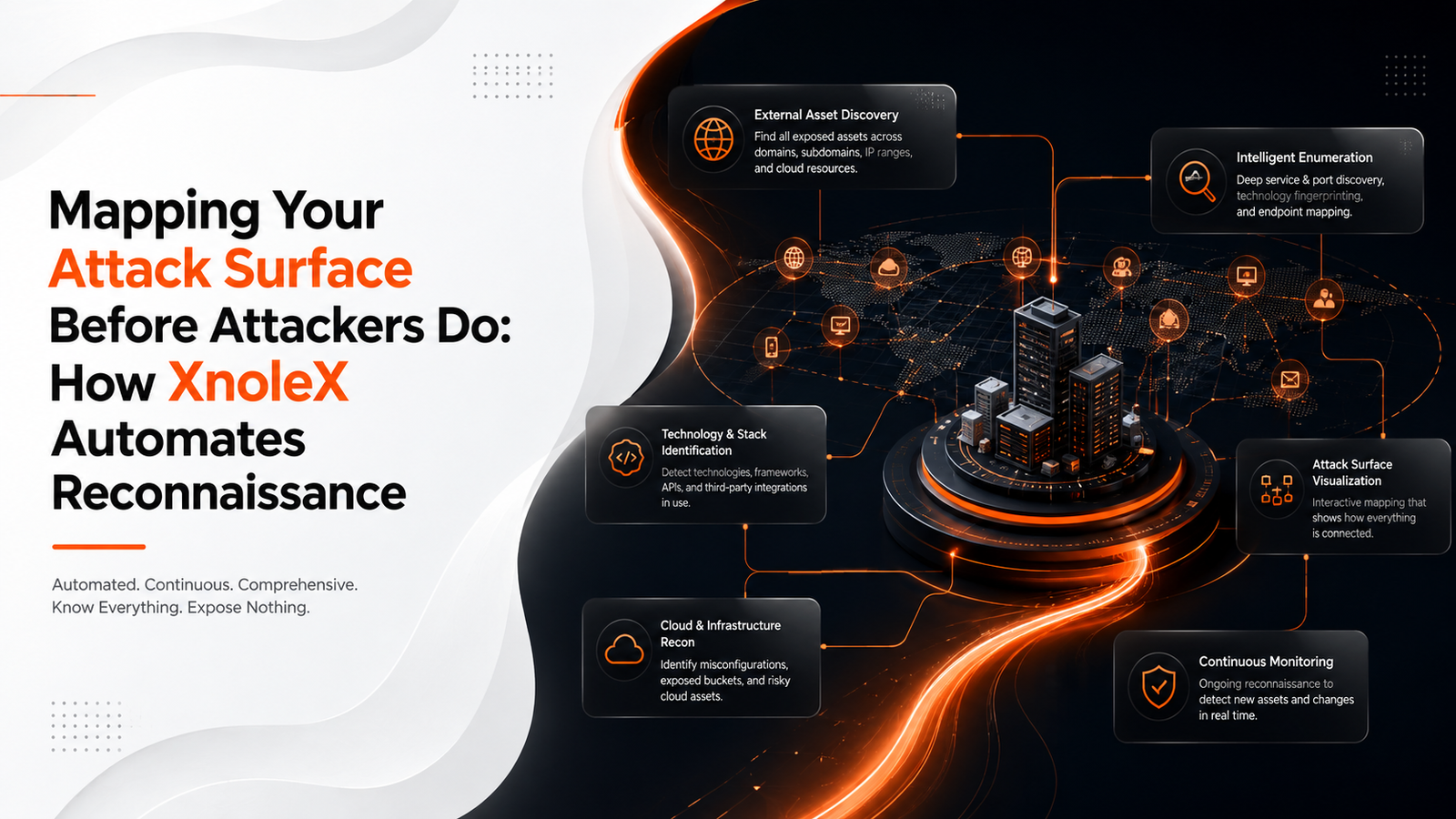
Attackers Don't Start Where You Defend
Every breach story has the same first chapter: reconnaissance. Before a single exploit is fired, an attacker maps your perimeter. They enumerate subdomains, discover live hosts, probe for HTTP services, and fingerprint the technologies behind every response. By the time they touch a vulnerability scanner, they already know your attack surface better than you do.
Most defenders still start from the other end. They harden the login page, patch the web app, and hope the rest of the perimeter is invisible. It isn't. The domains you forgot about, the staging environment that points to production data, the API subdomain nobody documented — those are the entry points attackers find first.
The fix is to flip the order: map the attack surface continuously, and treat that map as the foundation of every security decision. That's exactly what XnoleX's reconnaissance pipeline is built for.
The Recon Pipeline: Passive First, Active Second
XnoleX automates the standard recon workflow using the same tools security professionals run by hand — subfinder, nmap, httpx, and dig. The pipeline is deliberately ordered so passive techniques run before anything touches the target.
1. Subdomain Discovery (subfinder)
The first stage runs subfinder for passive subdomain enumeration. subfinder queries multiple public sources — Certificate Transparency logs, DNS datasets, and search engines — and returns subdomains without sending a single packet to your target.
subfinder -d <domain> -silent -timeout 60Because the enumeration is passive, an attacker gains no signal about your interest in a domain. Certificate Transparency alone is a goldmine: every TLS certificate ever issued for your domains is a public record of a hostname. Security teams forget hosts; certificate logs don't.
2. DNS Resolution (dig)
Each discovered subdomain is immediately resolved with dig +short. This maps every hostname to an IP address, which matters far more than most people realize. A subdomain resolving to a cloud provider's shared IP, an internal RFC1918 address, or a parked domain all tell a different story about the risk that host carries.
3. Host Discovery (nmap)
Next, nmap performs ping-sweep host discovery to verify which hosts are alive and surface subdomains that passive sources missed:
nmap -sn --open -T4 --max-retries 1 <domain>The -sn flag limits nmap to host discovery only — no port scanning, no aggressive probing. It simply confirms which targets are up. Results are deduplicated against the subfinder output so the final list has no repeats.
4. HTTP Service Mapping (httpx)
With a clean list of live subdomains, httpx probes each one for HTTP services, collecting status codes, page titles, and technology fingerprints:
httpx-pd -silent -status-code -title -tech-detect -follow-redirectsThis is where the map becomes actionable. A 200 OK on a docs subdomain and a 302 on an admin portal are different risk signals. Technology detection tells you which stack each host runs — useful both for attack surface triage and for inventory.
Correlation Is Where Recon Becomes Intelligence
Raw tool output is noise. The value of XnoleX's approach is that every stage feeds a single, unified data model:
- Subdomains — name, resolved IP, active status
- Endpoints — URL, HTTP method, response status code
- Technology fingerprints — framework, server, CMS per endpoint
Subdomains from subfinder and nmap are merged and deduplicated. Every subdomain is linked to its IP, its live endpoints, and the technologies those endpoints run. Instead of five disjoint spreadsheets, you get one correlated picture: which host runs what, and where it lives on the network.
This correlation layer is what separates an attack surface map from a DNS dump. When you look at a scan result, you can ask real questions: which endpoints are on the same IP as our production API? Which subdomain still runs an unpatched legacy CMS? The map answers them.
Why This Matters for Defenders
Automated recon changes the defender's relationship with their own perimeter in three ways:
It reveals forgotten assets. The highest-risk systems are usually the ones nobody remembers. Automated enumeration surfaces staging environments, legacy apps, and abandoned subdomains that manual inventory misses.
It gives you the attacker's view. You can't secure a perimeter you can't see. A continuous map of your external surface is the same reconnaissance an attacker would perform — done by you, first.
It feeds everything downstream. The endpoints discovered here become the input for vulnerability scanning. A better map means a more complete scan, which means fewer blind spots in the final risk picture.
The Takeaway
Reconnaissance isn't a phase you finish once. It's a continuous process, because your attack surface changes every time someone deploys a service, buys a domain, or spins up a staging environment.
XnoleX automates the entire pipeline — subdomain enumeration, DNS resolution, host discovery, and HTTP service mapping — and correlates the results into a single view of your external perimeter. Run it once for a baseline, then schedule it to keep the map honest.
Attackers will always start with recon. The question is whether you've already finished yours.